My Borrowed Garden in May

It’s probably my favourite gardening month, so I just had to write about my borrowed garden in May…

Upwards driven, arrow headed Aquilegia flowers begin to open, tainted only slightly by greenfly nestled in a few flower stalks – and not a ladybird to be seen.

De-headed tulips with their bleached foliage continue to fade from their recent fiery display, twisting this way and that, whilst continuing to roll ever inwards.

A cascading Gypsophila overflows its pot whilst flowering freely with dozens of tiny white trumpets, all worshiping the light, while from its Lewisia neighbour rise numerous slender stalks bearing exquisite pink blushed floral disks.
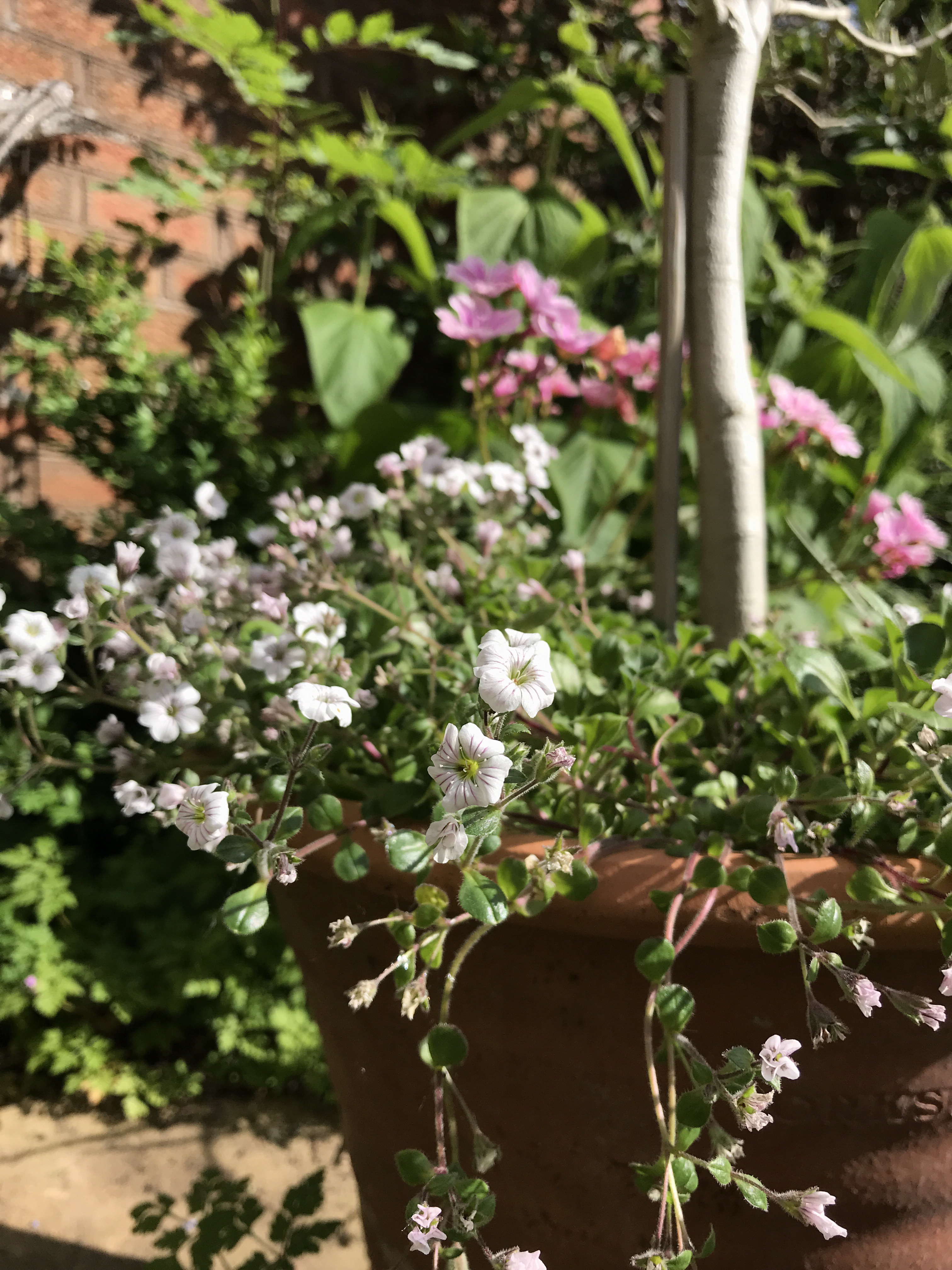
Gypsophilla cerastioides.

Accompanying the above mentioned delicate beauties are many cherished terracotta pots, each supporting a carefully chosen and treasured plant. The plants are not all star performers, some being the most ordinary specimens, but they’re my selections, my collection, and I appreciate each and every one for its own qualities. Collectively, they are my garden.

I have to say, there’s a good few immortal and less attractive plastic pots in use too, which refuse to die. Mind you, I can’t remember when I last threw a plastic pot away, as ‘they’ll all come in handy at some point’. If they’re here now, we might as well use them.

Overriding the flowers just now the foliage reigns supreme, with many textures and forms blending together in communities possibly never to be found in the wild. I would like to say it makes for a lovely floral display, or it’s a tapestry of colour, but to be honest it’s mostly green foliage, and I love it all the same. All that juice moving through the tiny vascular systems – refreshing, fascinating and energy giving.

Ensette ventricosum ‘Maurelii’

Lighter, clearly fresher foliage can be seen on a range of evergreen plants, from a pot restricted cedar in its early stages of topiary formation to a cloud trimmed, shrubby box in a heavy clay pot. Still, I can see at least a dozen different plants in flower, (not including the lawn daisies!) with the promise of many more to come.

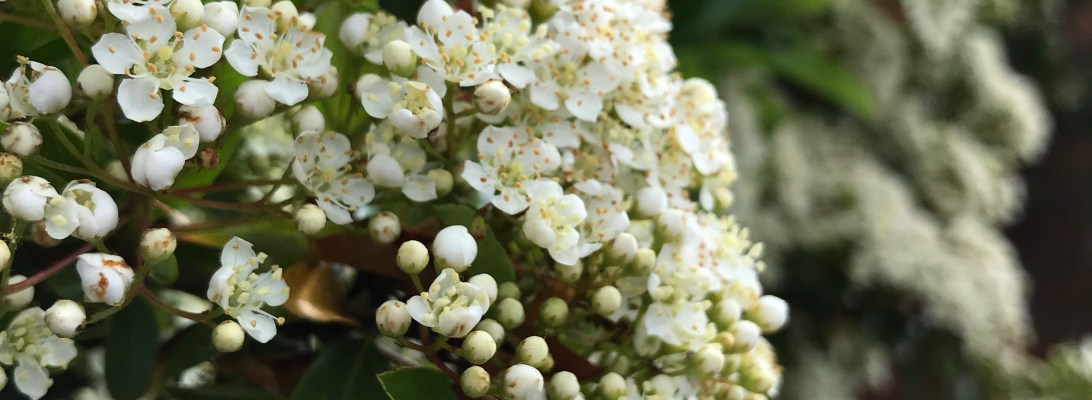
A curving rear wall supports a Pyracantha, which to my mind has been neatly trained over many years. It is just now reaching its first annual climax as it begins to burst its many champagne coloured flower clusters. I particularly like the informal holes where birds fly in to go bug hunting.
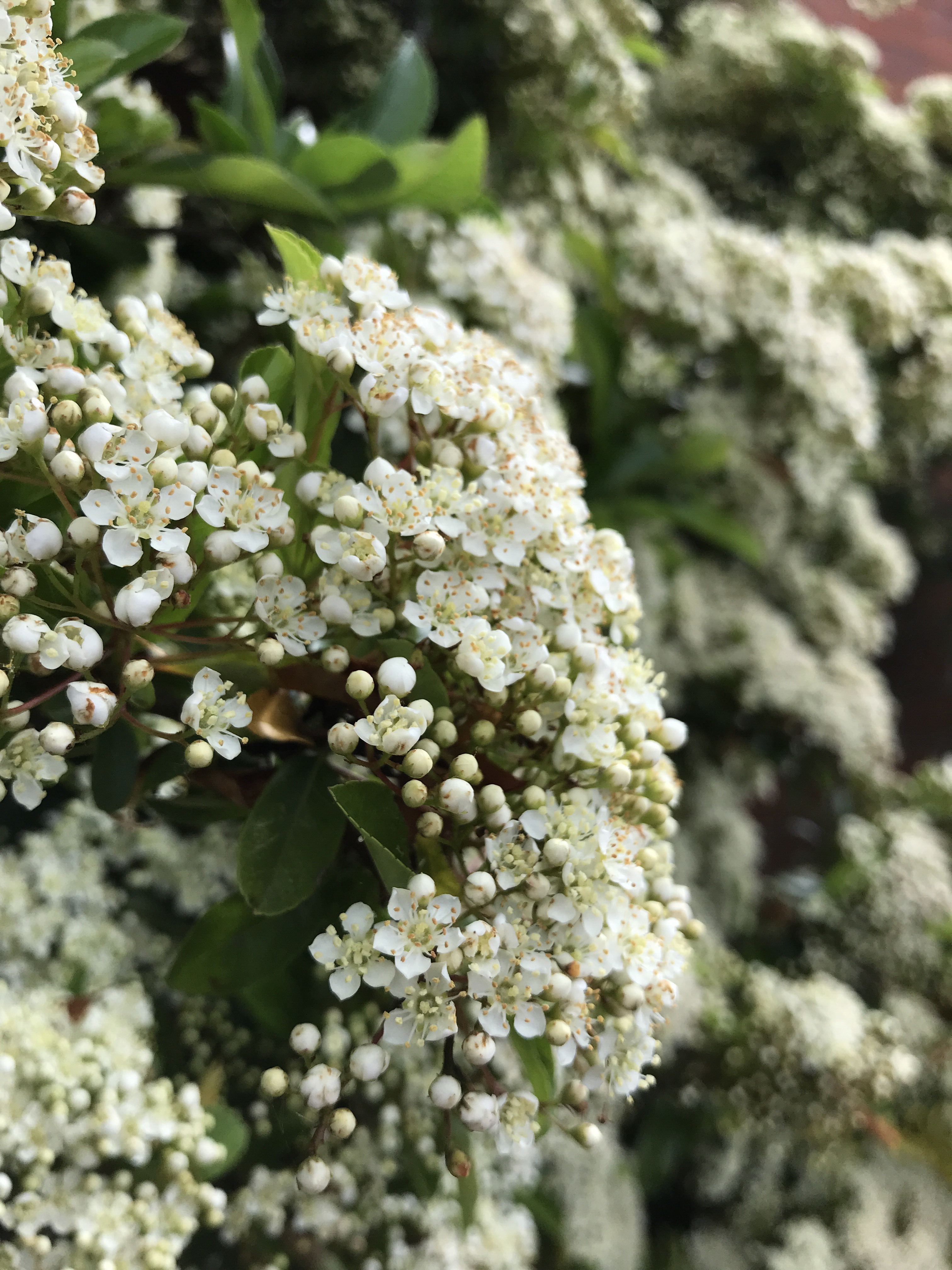
Pyracantha.

Along another border, waist high Miscanthus is beginning at last to own its space, whilst beneath and between forget-me-nots, the happiest of accidents light up the ground.

Directly opposite, the purple and mauve bells hang in fanned clusters from stout hairy stems, above the most giving of comfrey leaves. Beside this another happy accident, a Welsh poppy, demands attention with its wide open, paper-like orange petals.
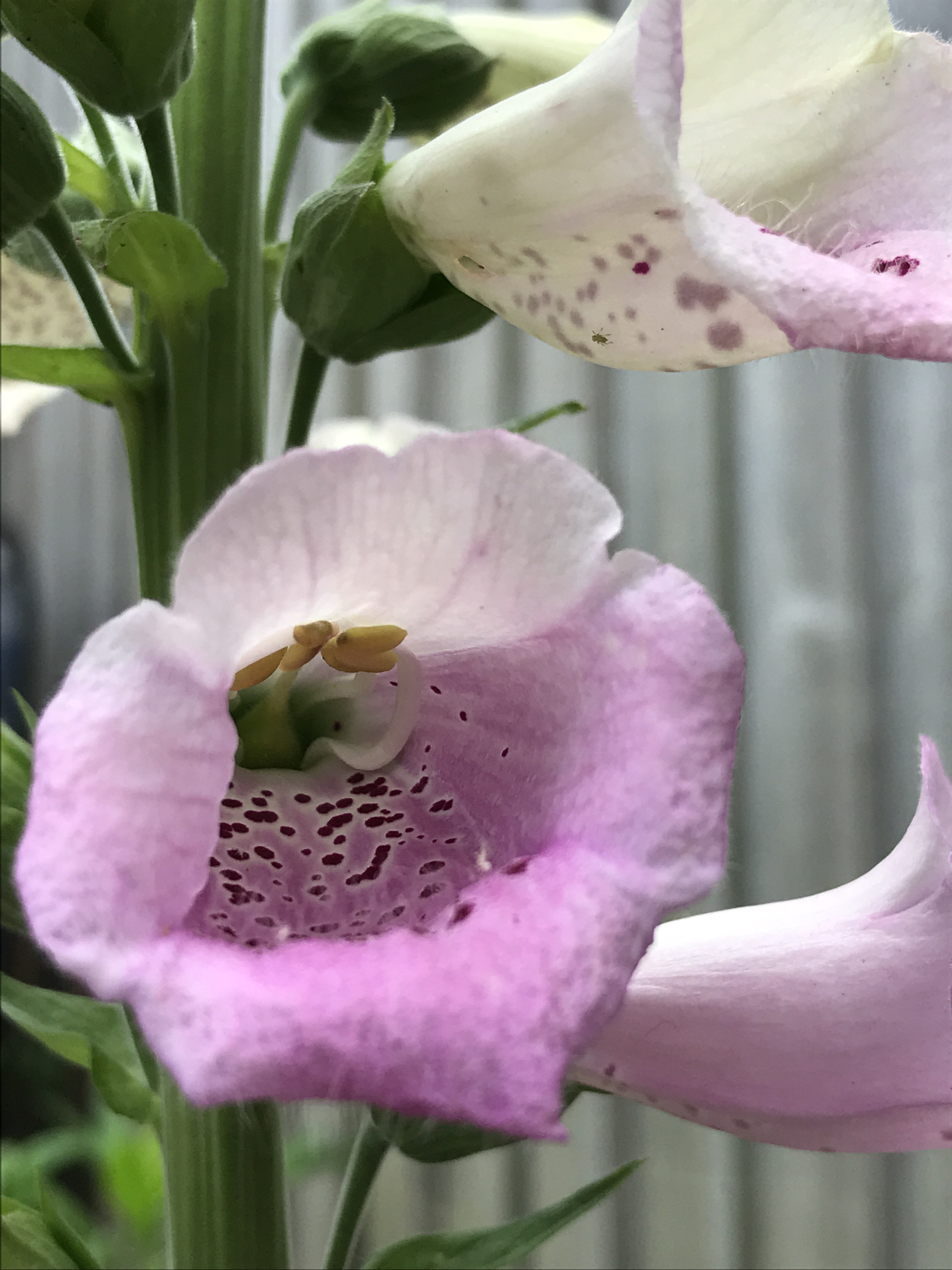
Digitalis purpurea.

Just a little further away a darkly coloured bugle sits unobtrusively beside a towering foxglove, its own statuesque form leaning slightly to catch the light. Each and every year I’m wowed by the strength and beauty of each little flower tube.

And finally on the face of the fence, and arching from a stringy framework of dubious strength climbs a young clematis, its white twisted petals finally open now to appreciate the sunlight. Of course, it wants to scramble every which way I don’t want for it, but it’s a delight nonetheless.

Clematis montana.

It’s a complicated but fun mix of pots in my garden, and especially lovely in May; probably my favourite month. Whether it is a borrowed garden or a gardener’s garden, or a bit of a shambles I don’t mind; it’s my oasis and it’s imperfectly perfect for me just now. I hope your gardening space is equally challenging, delightful and inspirational, and I’d love to hear about yours.

Regards, Gary

Pomp, Circumstance & a Touch of Mindfulness at Elgar’s Birthplace

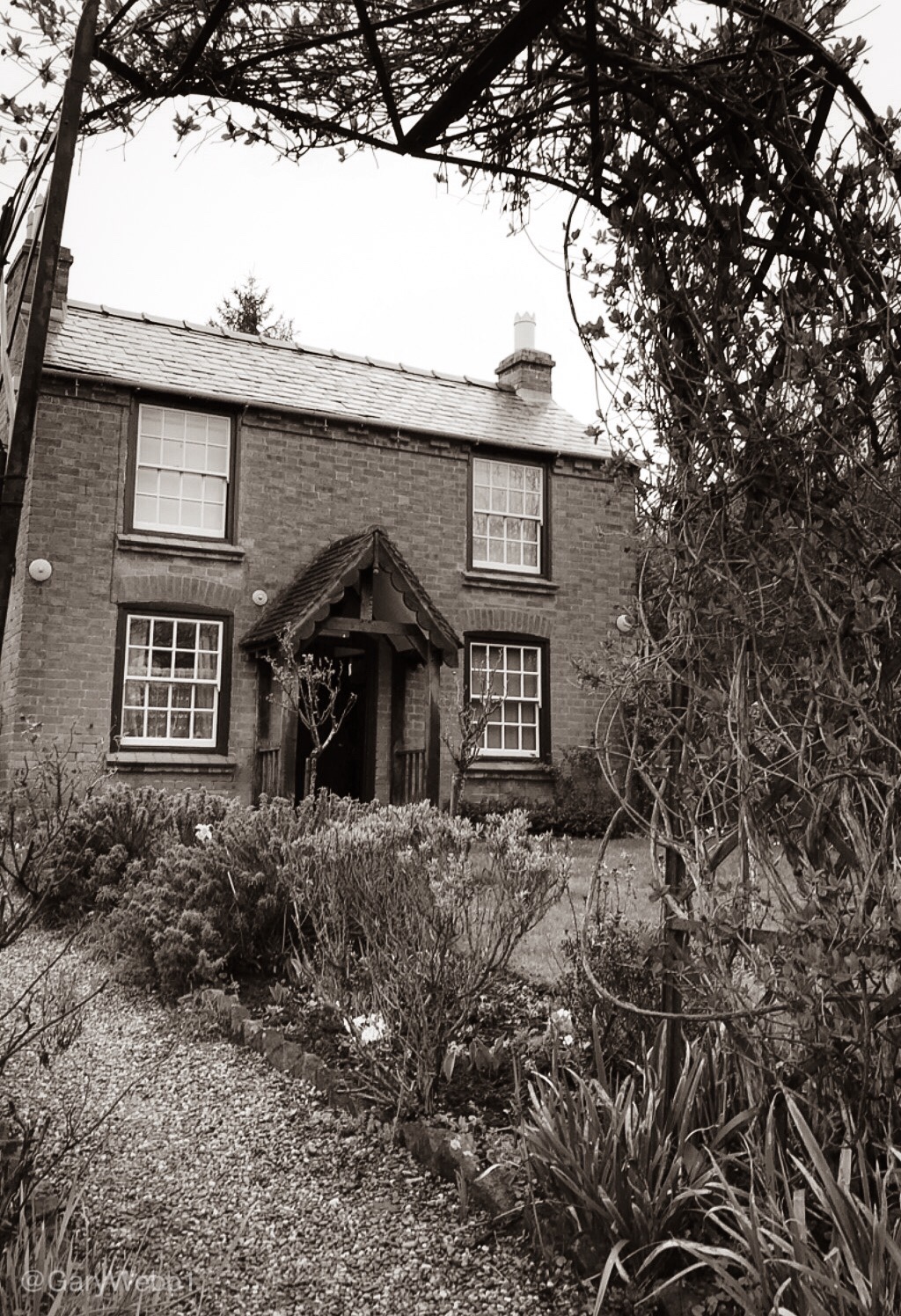
One breezy, rainy afternoon recently I made a curiosity visit to Elgar’s Birthplace, and enjoyed a pleasant surprise. To the uninitiated, Sir Edward William Elgar, (1857 -1934) was an English composer particularly noted for the Pomp and Circumstance Marches, Cello Concerto, and Salut d’Amour. He was born in a quaint red brick estate cottage known as The Firs, around 3 miles northwest of Worcester, now under the care of the National Trust.

Image of Elgar’s Birthplace, facing the Malvern Hills. Copyright: Gary Webb 2019

On the day of my visit the clay roof tiles glistened, cars splashed through puddles in the nearby lane and the Malvern hills were barely visible for cloud cover. This scene I describe created the most perfect collar gripping, hat pulling atmosphere for a visit, although causing an all-too-swift walk from the museum centre, through the garden, to the shelter of the front porch. The dimly lit rooms beyond, with music drifting through the upper floor were, I have to say, completely enchanting.

As mentioned, my visit was born out of curiosity and as such, I was in a casual, light-touch, information grazing kind of mind set. However, I couldn’t not listen Elgar’s music, which infused many of the museum spaces. I couldn’t not read the museum labels, stories and quotes, or watch the introductory video. Furthermore, I couldn’t miss the considered introductions the volunteers offered.

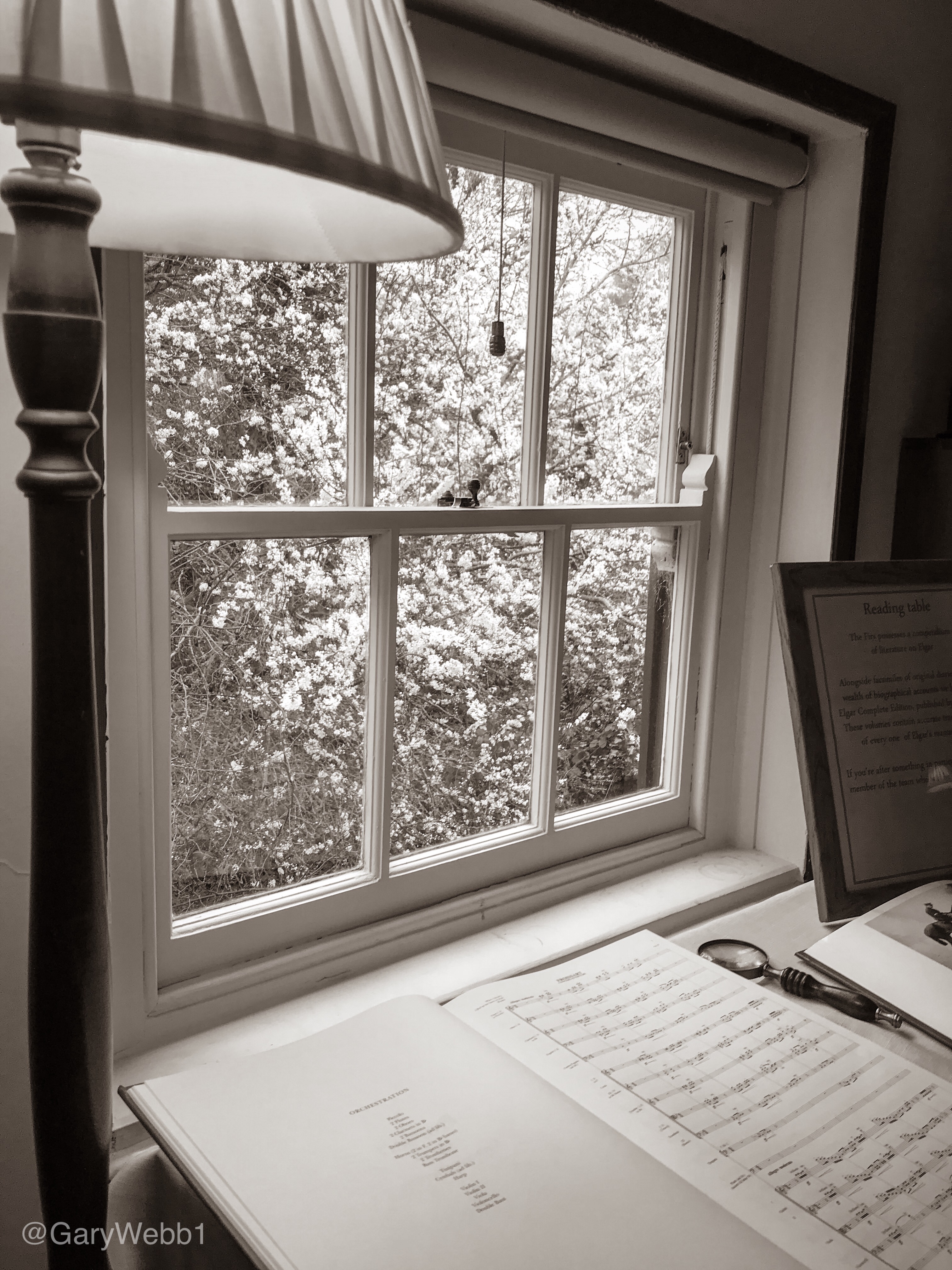
Looking back as I type, I can see that the visitor centre, birthplace cottage and the garden were delivering, for me at least, a consistent message. Supporting this message were the misty vista from the front porch, wind blown cherry blossom branches filling the bedroom window view, in fact the whole view looking out from the cottage. It all blended to hint, I believe, at a nourishing and guiding light in Elgar’s life: nature.

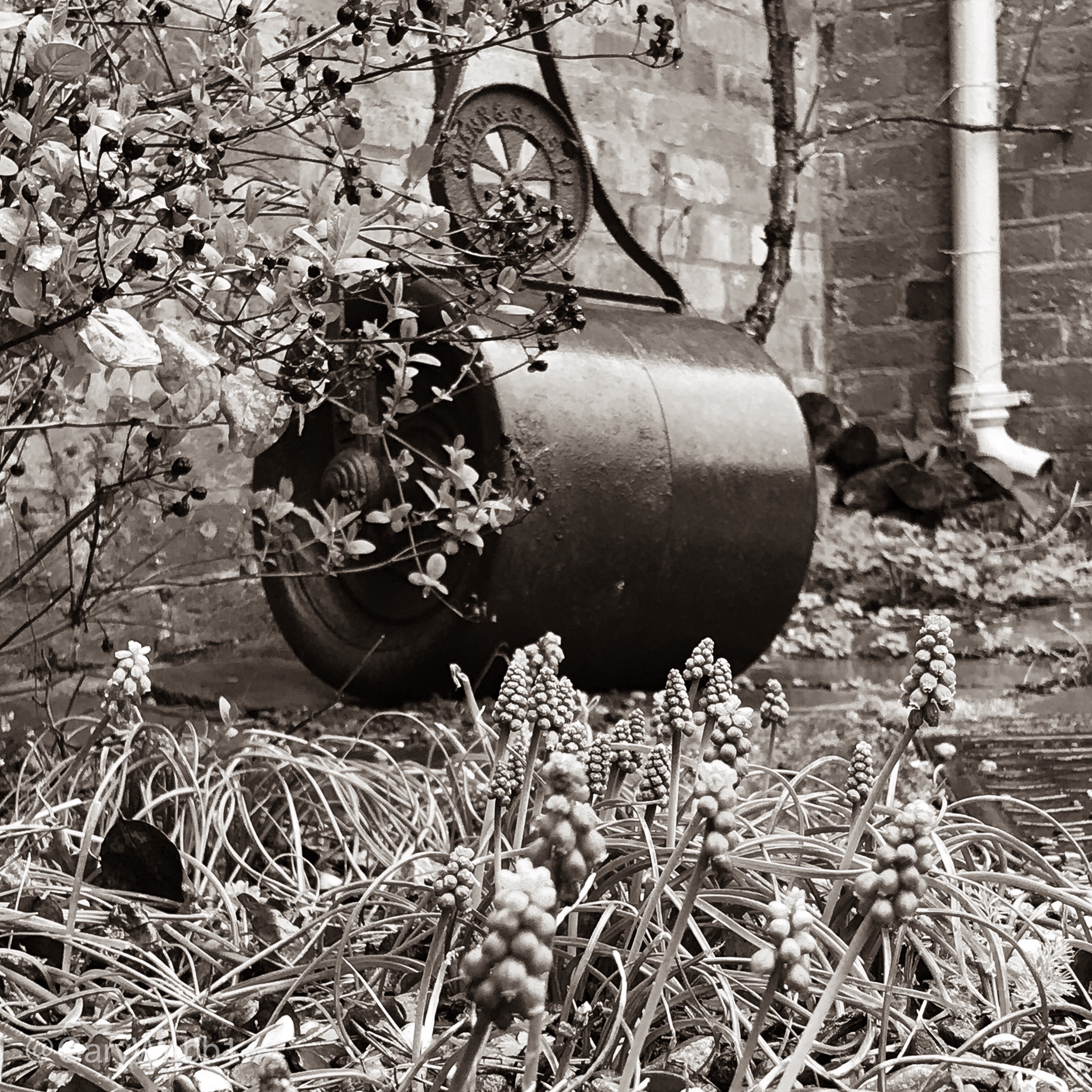
Grape hyacinths, or Muscari, before an antique garden roller at Elgar’s Birthplace. Copyright: Gary Webb 2019
Grape hyacinths before an antique garden roller at Elgar’s Birthplace. Copyright: Gary Webb 2019

Let’s be honest, I have spent a mere blip of time learning about Elgar, but I drew clear connections with him due to the way the museum has been presented, and the messages that unknown curators have brought to the fore. I learned less about what he composed, and more about how and why he composed – this, for me, was perfectly pitched.

“The trees are singing my music.” wrote Elgar from a home, Birchwood Lodge, in the saddle of the Malvern Hills.

I was challenged above all with the realisation that Elgar was very well aware of his need for mindfulness and wellbeing; things that are increasingly referred to everywhere these days. Sir Edward Elgar, despite being of another age and situation, appeared to face similar work, life, confidence, and creativity challenges as many people do today; and the museum engaged me in this aspect of Elgar’s life completely.

Museum text: “Elgar chased fame and fortune from a young age [but] on the other hand, he was happiest living the simple and rustic life that he had been afforded as a child. Often he’d retreat into the peace and serenity of nature when work commitments became too much for him.”

What materialised for me was that despite Elgar’s success, wealth and worldly travel; he still appeared to yearn for the peace, escape, and personal inspiration that the Malvern Hills and other rural places offered him. We’re all familiar with the ‘escape to the country’ idea, but for Elgar whose living and success depended on productivity; the inspiration and creativity he drew from the Malvern Hill, or nature generally, was clearly very important.

We may not all be creative composers, but most of us will recognise and identify with Elgar’s need to relax the mind. Creating that escape in order to properly refresh our minds and bodies helps to restore balance, and helps to prepare us for the next period of intense activity.

Cherry blossom filling a window view at Elgar’s Birthplace. Copyright: Gary Webb 2019

Elgar had certainly found his place, and one thing I took away from my visit was the need to find my own place. If I needed to further prove the point, I just turn again to Elgar’s example, who, although leaving his birthplace at the age of two, revisited often, retained a close connection with the area, and expressed a wish to purchase the The Firs if ever it were to become available.

Elgar wrote: “My idea is that there is music in the air, music all around us; the world is full of it, and you simply take as much as you require.”

Returning to the garden, the benches were sodden from rain, but I spent a good while in the garden whilst trying to pick up on its spirit of place.

The tall, rolling, country lane style hedges shivered in the breeze. Freshly composted, mixed cottage style borders were packed full of plants, and although hellebores and primroses drew the eye, the winter structure stole the show with standard roses, a range of budding shrubs and an ironwork arch over a path entwined with climbers.

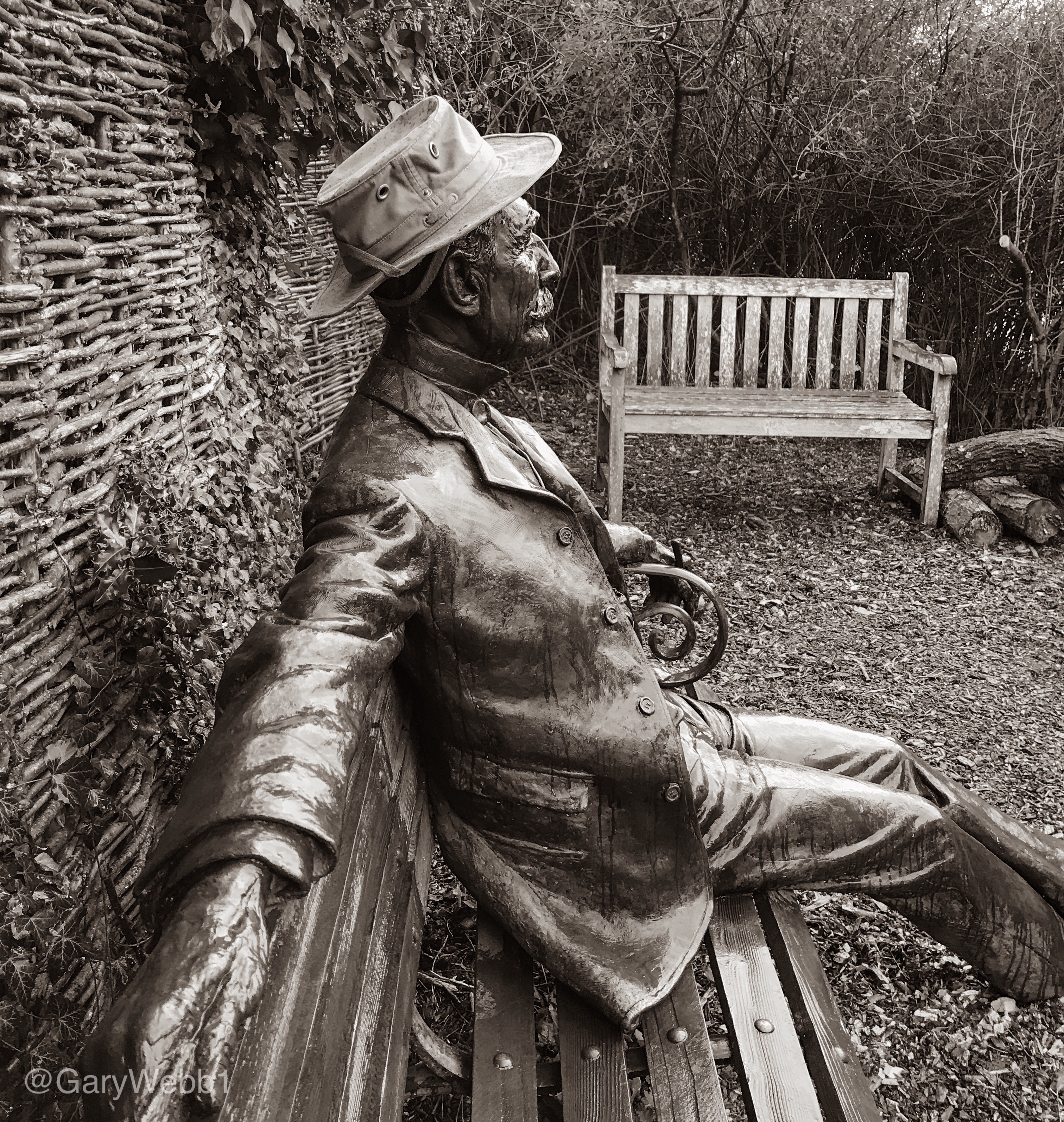
A rustic, thatched shelter nestled against a wattle fence, offering a shady place to perch. Gravel and wavy lined brick paths crossed the garden, and a bench in a far corner was itself a sculpture of Elgar relaxing whilst taking in the Malvern Hills vista.

A sculptural Malvern Hills view. Copyright: Gary Webb 2019

Clearly the garden, whole property even, had moved on with the passage of time, but generally appeared to hold true to its original form judging by the old images available. It was a delightful little garden and was so valuable in allowing me to experience the all-important rural idyll that was so very important to Elgar.

I completely tuned-in to his need for mindfulness, and for the need to invest in his core self; and in this respect, The Firs connected me with Elgar, and the environment, perfectly.

During his final illness in 1933, Elgar hummed a concerto’s first theme to a friend and said, “If ever after I’m dead you hear someone whistling this tune on the Malvern Hills, don’t be alarmed. It’s only me.”

Regards, Gary

For more information about The Firs, visit this link: https://www.nationaltrust.org.uk/the-firs

Where is Your Inspiration Destination?


I was asked a question last week which set me thinking; where outside of my workplace would I head to for inspiration?

Well I have to say that I do work in an inspiring place. It’s an art gallery and museum, and a real hive of activity and creativity. It is situated in a shallow, sculpted valley with a ribbon of water through its middle, and the surrounding hills are cloaked by farms and woodland.

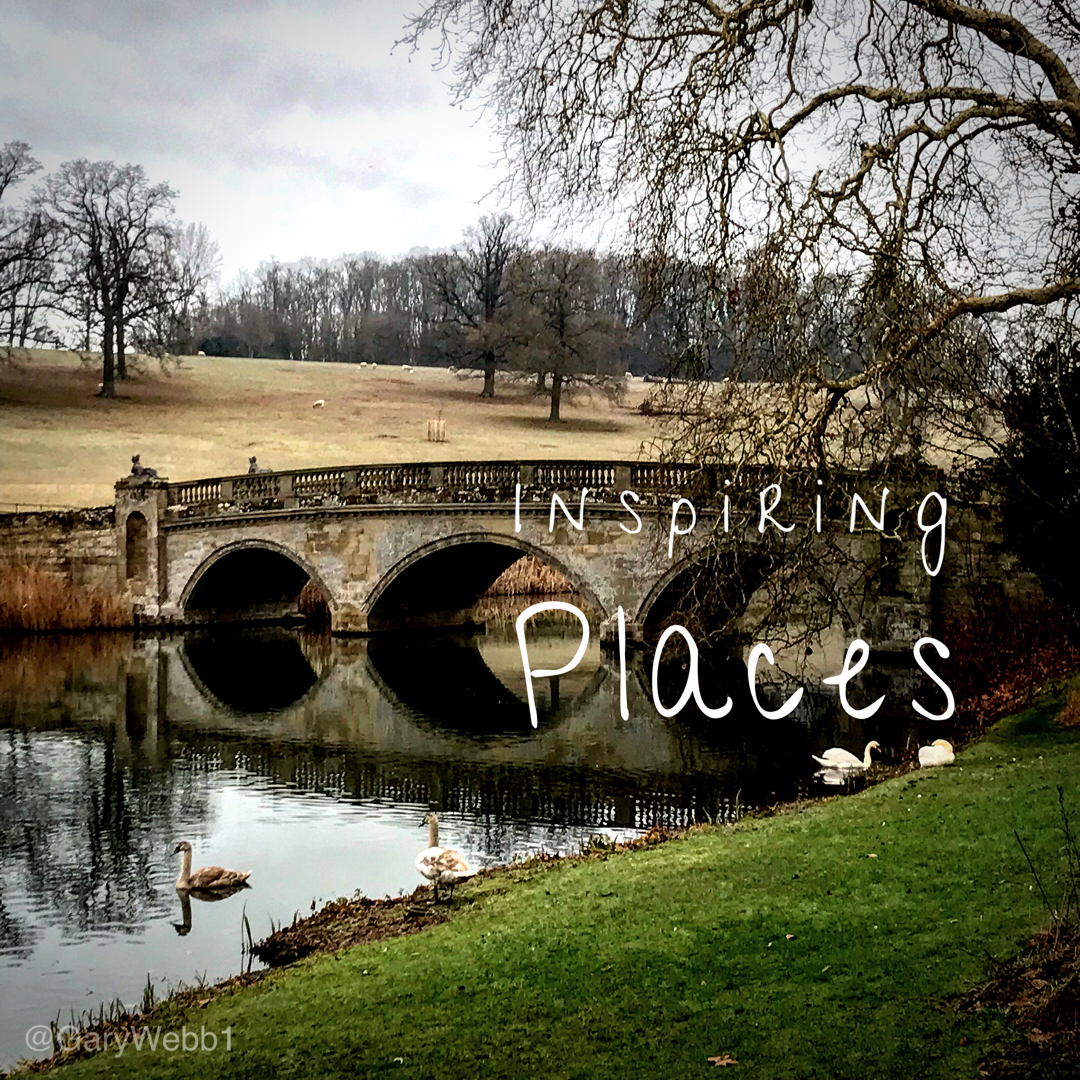
‘Capability’ Brown’s classical bridge in the landscape at Compton Verney. © Gary Webb

In its midst sit a cluster of strong, mellow toned stone buildings commissioned by a wealthy Lord; all linked with renowned architects of the eighteenth and nineteenth centuries. The venue is sprinkled with native and exotic plants and is a wildlife haven, playing host to a wide range of birds, badgers and rare bats; even visiting deer and otters add to the scene. 

After-all said and done though,  Continue reading

Reading the Landscape

Although a long time follower of ‘Capability’ Brown, I moved my focus recently to the first ‘official’ landscape gardener Humphry Repton. This may be a temporary flight of fancy, who knows, it has certainly opened my eyes though to some new ways of talking about and experiencing designed landscape. Here’s what happened…

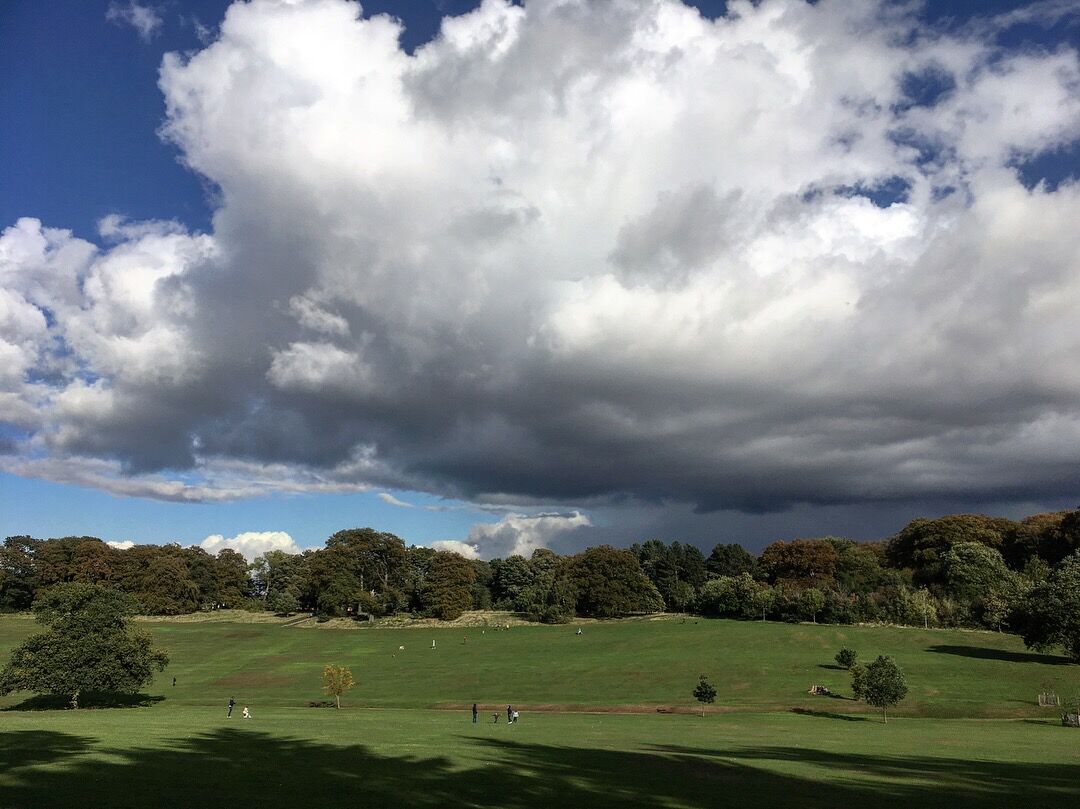
Cloudscape across the designed landscape at Warley Woods Park.

My shift of focus was to contribute to a Gardens Trust project titled ‘Sharing Repton’. As with Repton’s approach, the Garden Trust’s ambition for this project is no less striking or far reaching, and won substantial support from the Heritage Lottery Fund earlier this year.

Firstly and for the uninitiated, Continue reading