A personal response to the felled tree at Sycamore Gap.
There are so many trees I have yet to converse with, but I do count myself fortunate to have encountered the Sycamore Gap tree a couple of times; a tree that’s mysteriously and defiantly prospored beside the mighty Hadrian’s Wall in Northumberland. The fact that this tree even established itself, let alone lived this long time and in such exquisite form, is nothing short of a miracle.
I remember my first glimpse from the road of the tree nestled in its gap, and eventually on foot when I paused on the bank above, not wanting to rush my arrival but absorb the tree from on high. I paused awkwardly, but repeatedly all the way down the steps to the bottom of the gap, wanting to catch a glimpse into the tree’s crown without wishing to hold up the steady stream of walkers.
Once at the bottom of the gap I walked away from the tree to find my space, a place to wait and observe; rushing up to the tree didn’t feel right. At a distance and from a rocky seat, I could properly look on whilst trying to understand what made this tree, a simple sycamore, so special.
I’ve met so many sycamores or ‘Great Maples’ in my time, many having proudly stood in prominent places with their flaky trunks and large often
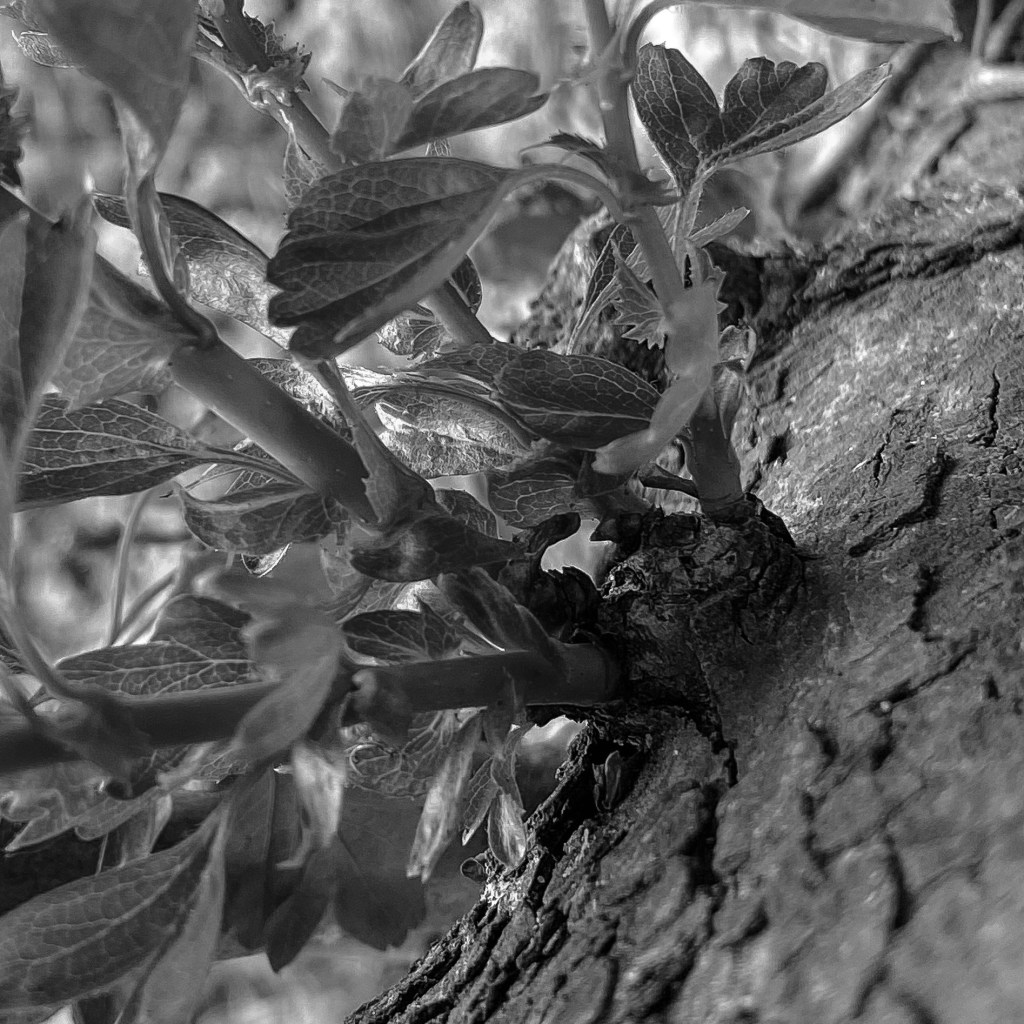
Out of cold grey metal-hardened bark, the softest greenest shoots miraculously appear each spring. Keen new growth for a new season appears from tangled stand alone trees, or from individuals intertwined within field hedgerow communities.
Wire thin, pliable and verdant stems along with tiny fan shaped leaves build and stretch themselves towards the light. As growing days pass,
It was an arboretum day filled with the brightest sunshine that beamed down between dense, top-lit clouds. To my foreground amongst grassy blades clothing two falling lawns, dozens of grape hyacinths were enjoying their moment, each with clusters of flowers no bigger than my thumb nail and shaded top to bottom with the lightest powder blue almost to black.
The Japanese style resting house under whose roof I sat, looked out over those flowers and a larger expanse of mown lawn that continued to fall gently away, eventually connecting to a wide and spectacular
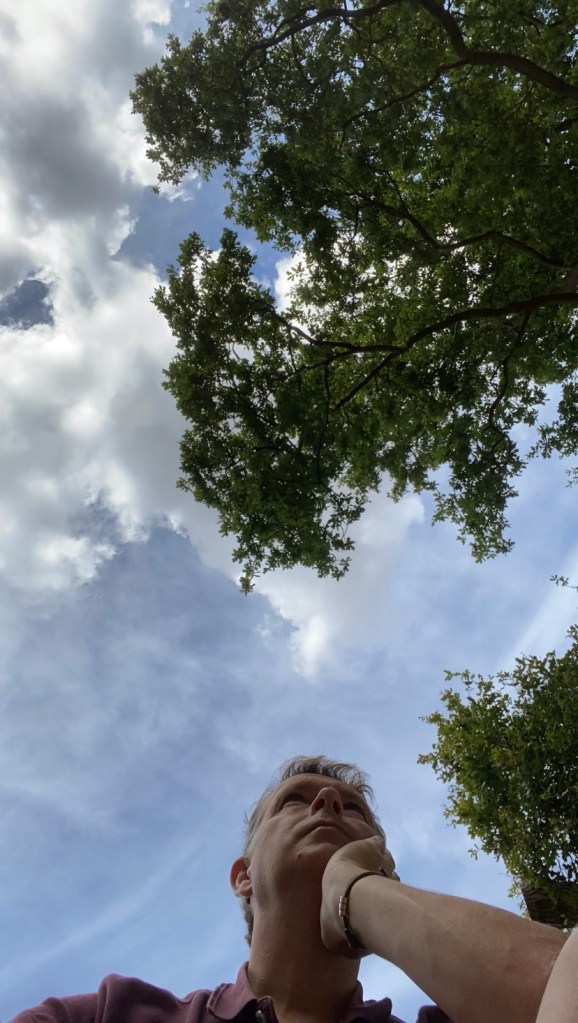
In a far corner of an old deer park I rest for a while beneath century-old oaks, perched amongst tussocky grass on a log with just enough movement to rock gently back and forth. As I settle a glittery turquoise dragonfly zigzags by.
After a while I close my eyes to ‘tune in’, first to grassy stalks that tickle my ankles, then to the coarse bark that will no doubt leave an impression, soon after though, to the gentle waves of warm breeze that pat my legs and cheeks. The aroma is, as I’d expect, carrying a distinct whiff of deer and sheep.
Alternative layers of sound now begin to present themselves. Engines, one from a small propeller plane buzzing whilst ascending from the nearby airfield, then another more distant roar from a jet passenger plane passing high above. Both though are eclipsed, to me at least, as I restore focus to the nearer sound of the breeze that is rushing over, around and past countless oak leaves in the tree tops overhead.
Clouds moving constantly towards the southwest provide distinct periods of lightness and shade, warming on the whole but occasionally less so. On today’s summer day it is sandals and shades, tomorrow, due soon enough it’ll be boots and scarves.
On this day though, I’m enjoying just a few minutes idling, just listening and looking; valuable moments of peace in an idyllic location. All moments sat on this uneven log are well-spent ones as they progressively calm, nurture and nourish my own personal inner being.
As I tune in to everything around, expectations on me and my world, for a few moments at least, diminish. Schedules, plans and priorities are subdued, ambitions and worldly goals are hidden, as the environment around me speaks ever louder. Even the interruptions of passing engines leave me feeling no: not me, not now, not today, I’m happy right here on this piece of wood.
I’ll return to that log, to those aromas and the ankle-tickling grass again this week during moments of remembrance. Closing my eyes will transport me back so that I can again listen to the trees and feel the sun’s warmth on my skin.
The value of managed landscapes is immense, and I urge anyone, if you’ve not already done so to find your log, your bench or place to park, relax and free your mind. I can’t recommend it highly enough.
Tall, broad, weeping or not, most people love trees, even if they fail to realise it. Trees texturise our world, from landscapes with twisted ancient groves, in tucked away valleys, to clipped street trees or standard fruit trees in a homely garden.
Trees grow, attract, and enrich life, they even produce the air that gives us life. Yet, as tough as trees are, if storm events have taught us anything, it is that trees are at risk and vulnerable.
It is commonly taken that mature trees are solid and everlasting. Their roots will have spread far through the earth, having driven themselves between miniscule particles in every direction, anchoring every specimen firmly to its spot.
In many species, thick, ridged bark encloses and protects softer inner tissue within a trunk. Yet as we look higher, increasingly smoother and more flexible bark can be found cloaking branches, stems and twigs, where frequent breeze driven movement is guaranteed.
Trees then, with their strong cores, space owning crowns and flexible tops are dynamic, strong and resilient. They’ve evolved to endure, to last, and to grow in number in most environments, indeed, some examples are proven to have lived for centuries.
But when storms touch down, I worry, for each and every unshielded champion. Decayed twigs will rain down for sure, inflexible branches will fracture and fall, to spear the soil or shatter upon the ground below.
Wind waves will rock stems and heave root-plates until long established roots are torn apart. Trees therefore, our constant companions are vulnerable, and once touched personally by a storm are rarely the same again.
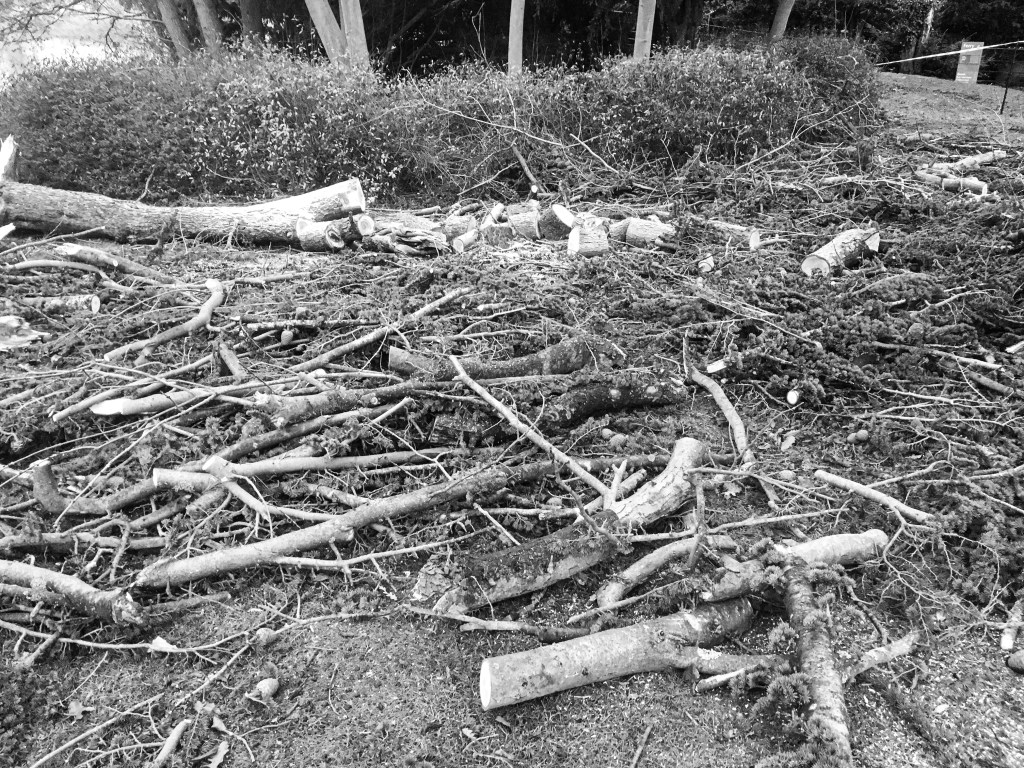
Seeing footage of trees snapping, shattering and toppling over recent days should leave an impression, as it has for many storm events in history. Having worked on many cleanup sessions where fallen wood lay strewn across wide areas, and where mud, sweat and tears were inseparable, I also feel for those who are tasked with the unenviable task of clearing away the remains.
Trees will always be at risk from storm events, that is a fact, and dealing with broken trees will always be a labour of love. But trees are, in the main, survivors. Like humans, they will in most cases find a way to endure and adapt, and it helps to take inspiration from this.
Trees and people are interlinked, and we must continue to invest in them and support their survival; especially where we’ve made environments so challenging for them. We have been fed, clothed, housed and warmed by trees since the beginning of time, we have even been transported around the globe by them, and we should respect that.
If then we lose faith in our trees, if we begin to worry that repairing or replanting a tree isn’t worth the expense, worry or risk, then I’d urge us as a community to think again. We must especially preserve veteran and ancient trees carefully, for unlike buildings, which have the potential to rise again from the ashes, trees never can.
Through any storm, irreplaceable, historically or botanically important specimens will fall, and their presence will be mourned by many. But in response, what should we do? How can we fill the vacant space that inevitably is left behind?
Practically, I suggest we look closer at the mechanics of any storm individually, and at each particular tree that has been impacted. I would also suggest looking to those trees nearby which survived the storm and ask questions of them: How did they weather the storm? Are replacements available in case they were to fall in future? Is there anything we can do to protect them? We must not just clear up and put the sorry event behind us, but learn from it.
There is much to learn from storms and the attention they bestow on our beloved trees. Survive them we must, but learn from the wreckage what we can before focusing on the new opportunities that will present themselves; for a new generation of life-giving companions.
Plant trees for your grand children, as they say, or plant trees for yourself. Whatever the reason; just keep on planting! 🌳🌳🌳.
Gary Webb,
Gardening Ways – a personal blog about plants and gardens.
I’ve been wanting to write a little piece about trees for a while now, but as often the way, it’s been just another post on the to-do list. However, when our friends on BBC Gardeners’ World produced a special program dedicated to trees, I was inspired to get out my notes and to revisit that post I’ve been meaning to write.
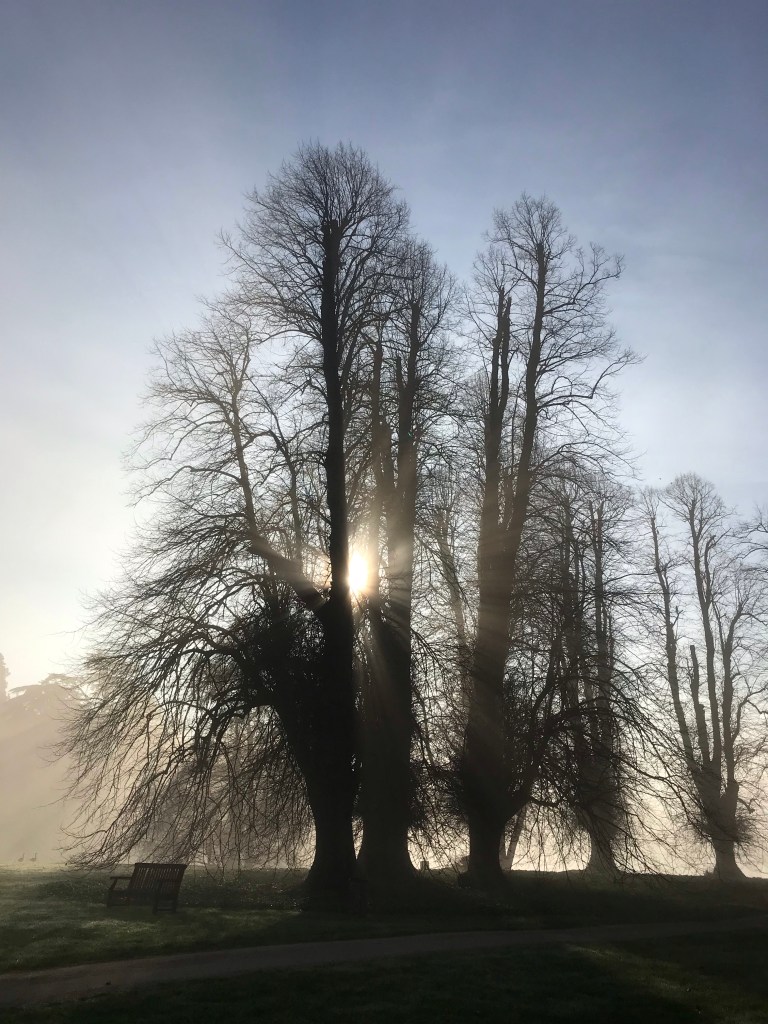
Limes in the morning mist.
Like many other people, I’ve a long held interest and fascination for trees, and not least for the fact they can grow from the smallest wind blown seed to enormous, living and breathing structures. How they establish a root hold and adapt their growth, melding with the environment they find themselves in is nothing short of extraordinary.
In my formative years as a gardener, I can honestly say that I never thought that trees would play such a significant part. I mean, I learnt about them, planted a few, chopped bits off a few more and did my fair share of ident’ sessions, but did I really get to know and understand trees?
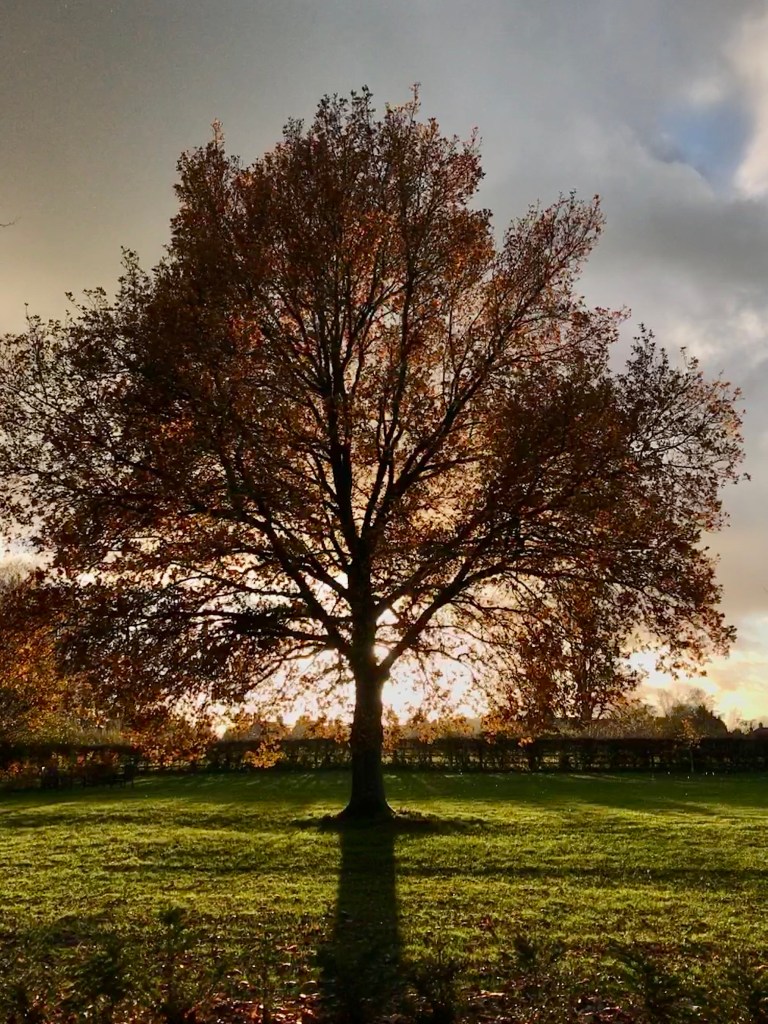
A backlit autumnal oak at Sulgrave Manor
Naturally I grew up with trees all around, as most people do: trees in our family gardens and down the street, a huge conker tree in the school playground, even the Christmas tree in the corner each December. (OK, maybe that last one was a bit of a stretch!) But did I really take proper notice of them?
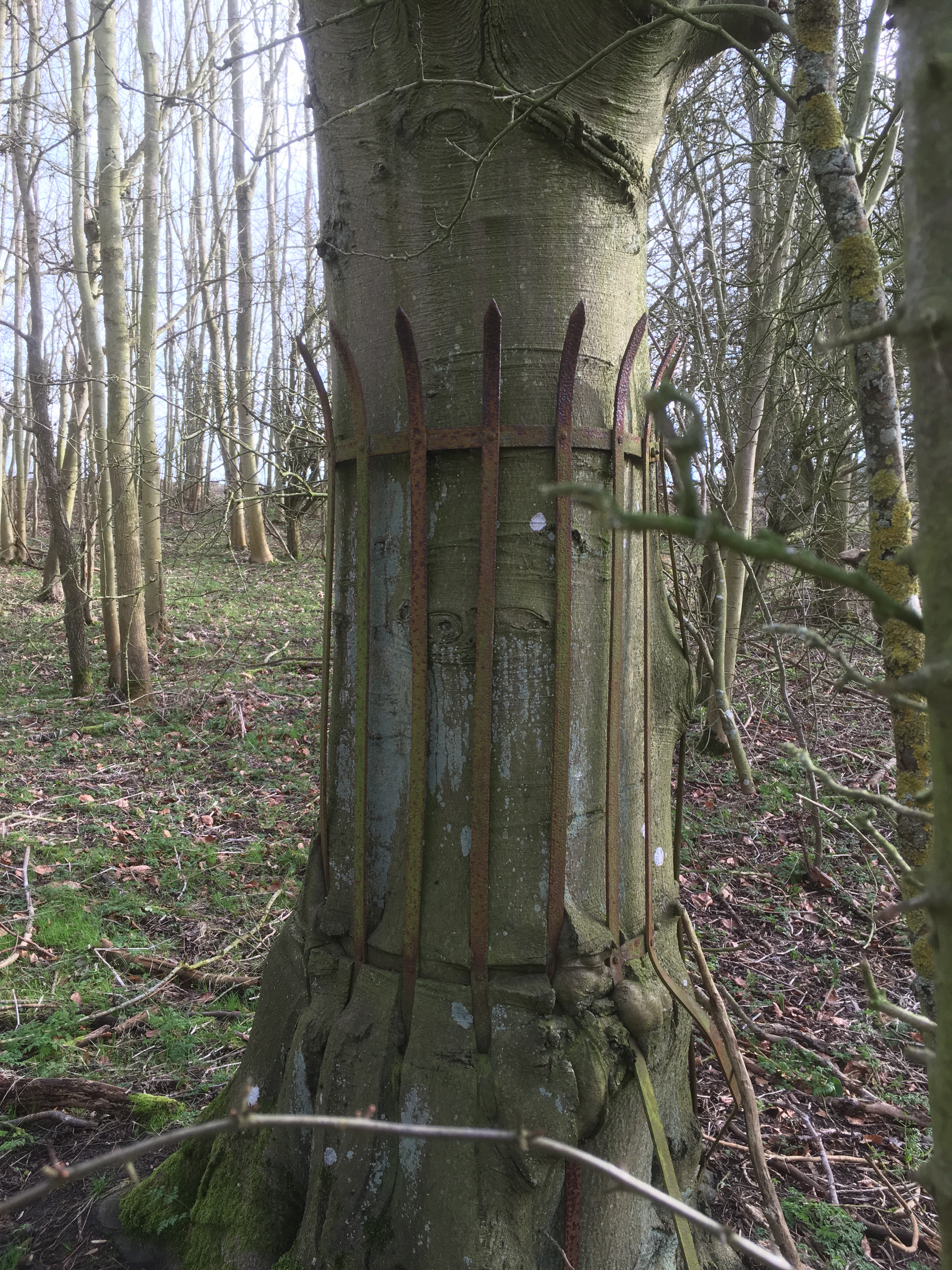
Tortured Trees – Planted and Forgotten…
It is a beautiful, strong and solid beech tree, and is situated on a gradual slope that forms part of an historic, designed landscape that has seen varying degrees of management, by generations of land owners and estate workers. Continue reading →



 Gardening Ways