Do you have a sensory garden? If not, are you sure?
I find myself sitting at a little bistro table in my garden with fingertips poised near the keyboard. It’ll be my first post for a few weeks you see, after life, as it does, got a little heavy. But with a few moments of peace available I’m determined to reignite my writing brain and post something interesting, or useful at least so here goes; a post about my sensory garden.
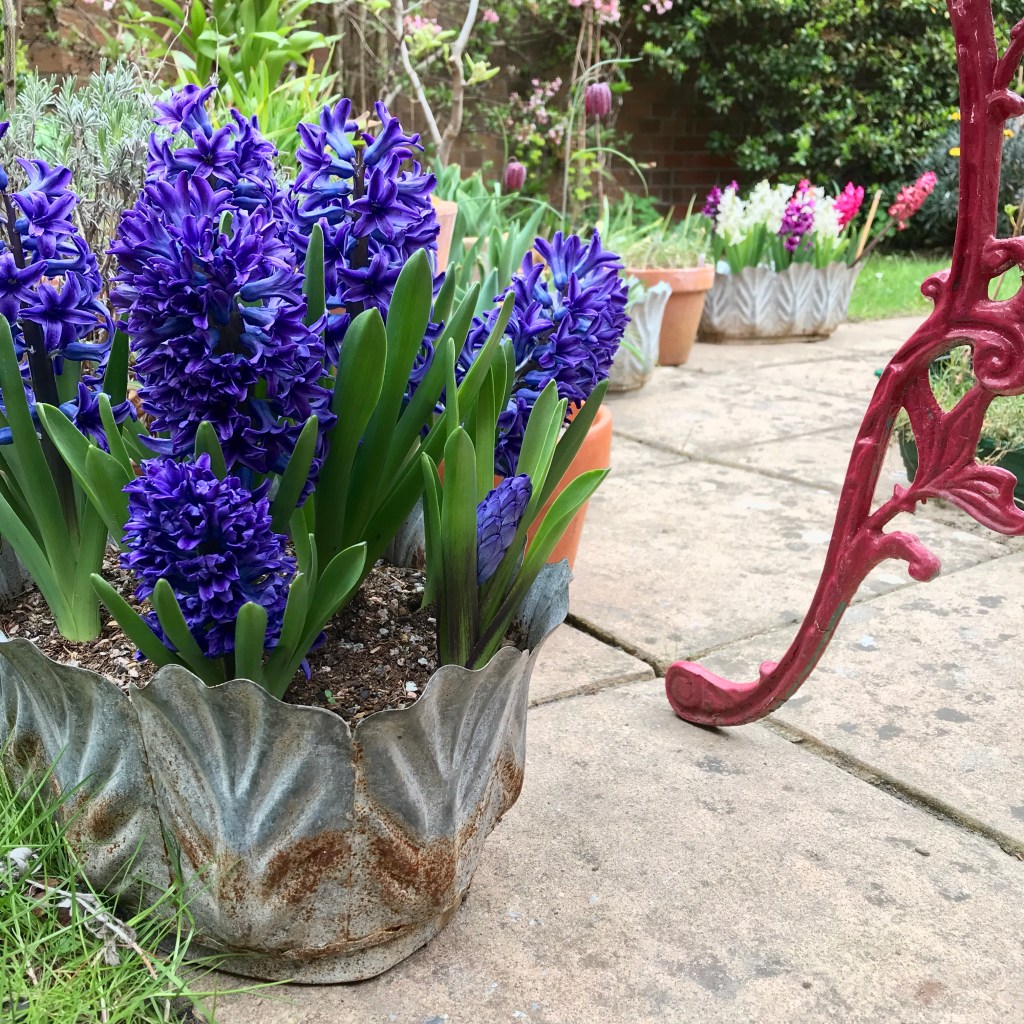
Hyacinths punch well above their weight in terms of scent – these are incredible!
Whether we believe in Blue Monday or not, many people do feel down in January, maybe because of all the hype and increased activity of the festive period. In truth though, there can be many times throughout the year when our spirits can for whatever reason, drop. Feeling over-worked, stressed, overwhelmed or just a little lacklustre, all are common feelings to many people at one point or another. But there’s hope…
One thing I have come to understand is that I definitely need quality time alone to unwind and recharge, maybe you feel the same too? “Ha!” I hear some people say, “like when do I ever get quality time to myself?!” Well, I’m familiar with this as well – very much so.
Now, I’m fortunate to work in the field of horticulture, which is to say that I spend most of my working days gardening. Something I’ve realised recently is that whilst I’ve prepared, restored and created gardens for people to visit, enjoy and relax in, I’ve also been able to experience these myself, even whilst busily working away.
Whilst in these spaces, I’ve always remained aware of the busy, thriving world outside because of lorries in the distance, jet planes overhead, ‘trends’ seen on social media during tea break and even by email – and yes, gardeners do get emails! Either way, I know that I’m never really that far away from the hustle and bustle yet, whilst I’ve been in my garden space, I have in a way been enjoying respite away from that congested, energy sapping world outside.
Please don’t misunderstand me, gardening is all-engaging, can be very stressful in many positions, and often, when a calm day of gardening appears to be ahead, a physically and mentally challenging day actually unfolds. Yet, through my work I’ve come to understand how, when ‘at one’ with nature and the green, growing environment; I can be completely calm and at my happiest.
I’ve also met many garden visitors and heard countless comments about how they love visiting and just being in gardens. “I love it here,” is something I’ve heard often. I’m completely sold therefore on the concept that gardens, woodlands, landscape and the outdoors in general can offer more nourishment to an individual than may be quantified. Put simply, if there’s a green space where one can be alone for a while to escape from the hectic world around, or even from a situation that needs more thought, then surely it must be a good thing for the individual.
Well, to get to my point, I’d like to introduce you to a set of green spaces where you can head for restorative purposes – and to an initiative that is ‘Silent Space’.
I will not attempt to explain at length, for it’s very simple – Silent Space encourages us to put our phones aside and to take a moment in a garden or green space. For all the reasons mentioned above, and more, Silent Space is an initiative that empowers us to breathe in the green space around us, to reconnect with nature, and to revive our spirits.
Where? You might ask, as often there are no quiet places nearby that ever come to mind for this sort of activity. But stress not, for wonderful people who believe in Silent Space have already prepared and opened areas of their gardens and venues as Silent Spaces, for you to visit.
Silent Space at Waterperry Gardens
True, if your garden or the park down the lane offers you a place for solace, then embrace it and use it, but the silent space I refer to here may just takes things up a notch or two.
The single link that follows will take you not just to a website, but to a growing world of much needed Silent Spaces that may offer exactly what you’re looking for. A growing number of gardens and landscapes are featured, and there’s likely to be one near you to try this year, and if there’s not, then why not ask for one, for Silent Space offers us so much, & is sure to keep growing…
“Gardeners, I think, dream bigger dreams than emperors.”
Mary Cantwell (1930-2000)
When I read the above quote from Mary Cantwell, an American journalist and novelist I believe, it certainly set my mind thinking. It reads simply, initially, and for me sparked inspirational thinking in relation to gardening projects or garden expansion. It made me think of growing more challenging, bigger and unique specimen plants, and it reminded me of my bucket list of gardens to visit in exotic, far-flung locations.
The quote could therefore be a simple, straight forward vehicle to encourage bigger thinking, like that expected of an emperor, but by an ordinary person. I guess it naturally sets a gardener’s station relatively low, but instantly lifts that station through some easy to achieve, bigger dreaming; and I have no worries where that’s concerned.
Nevertheless, whilst I doubt that Mary intended to speak directly to gardeners, the quote does take on a new meaning when I read it purely from my perspective as a gardener. I can see for example that the apparently simple quote could have deeper notes; notes that instantly make it more relevant to me on a daily basis. Let me briefly explain…
When I dream, day-dream that is, I’m often seeing gardens.
Or more specifically; I’m seeing garden spaces as parts of a larger garden. I might
have an ornamental border in mind that is ready for change, or occasionally a larger
space to work with and think about. Either way, the space is very rarely a completely
blank canvas.
To this end as a gardener, I have to dream. I have to time travel and look into an imagined future to see the plants growing and to see the space fully developed. I’d also say that it’s not just me but we, as a creative gardening community that need to dream on a daily basis in order to achieve a reality that many people enjoy.
We have to dream that journey of each plant and its growth from seed – to sometimes gigantic proportions. To know the vulnerability of each plant is to encourage dreaming that enables ‘sight’ of the plant growing, and enables us to know that plant in its mature form, with competing plants all around.
In that dream-zone we have to make allowance for the challenges each plant will face along the way. Animal and human pests, accidents, stress, neglect and extreme weather will challenge the existence of each plant and garden. That imaginary journey of each plant will therefore trigger precautionary or protective measures to ensure the best chance of success, and it will certainly lead us to delete a dozen plants from any wish list before a single seed is sown, or plant ordered.
Gardeners do though have to understand the reality behind the dream, the processes and resources that enable us to grow from seed, to nurture cuttings or select plants. Gardeners also, sadly, have to understand how other factors may impact the future of a garden. Changing attitudes can sweep away a gardener’s dreams almost overnight. Each new generation can play to the new fashion; and a whole garden can all too easily be swept away with a new broom. Understanding that reality means that a gardener must dream and see the final vision, in order to make the often challenging journey bearable.
Finally, therefore, to return to the quote about gardeners who dream bigger than emperors; I have to say that I agree on all levels. To undervalue that ability to dream big is to stifle imagination, and to prevent the creation of something that may to one person be distasteful, but to another be beautiful, restorative, and life changing.
Gardeners ought to be encouraged to dream, for it is they who create, adapt and grow the unique and heavenly places so important to us all.
Perhaps we shouldn’t tease someone who appears to be day dreaming today, for in ten years we may be applauding their great gardening achievements, and in fifty years we may be celebrating their visionary foresight….
It’s probably my favourite gardening month, so I just had to write about my borrowed garden in May…
Upwards driven, arrow headed Aquilegia flowers begin to open, tainted only slightly by greenfly nestled in a few flower stalks – and not a ladybird to be seen.
De-headed tulips with their bleached foliage continue to
fade from their recent fiery display, twisting this way and that, whilst continuing
to roll ever inwards.
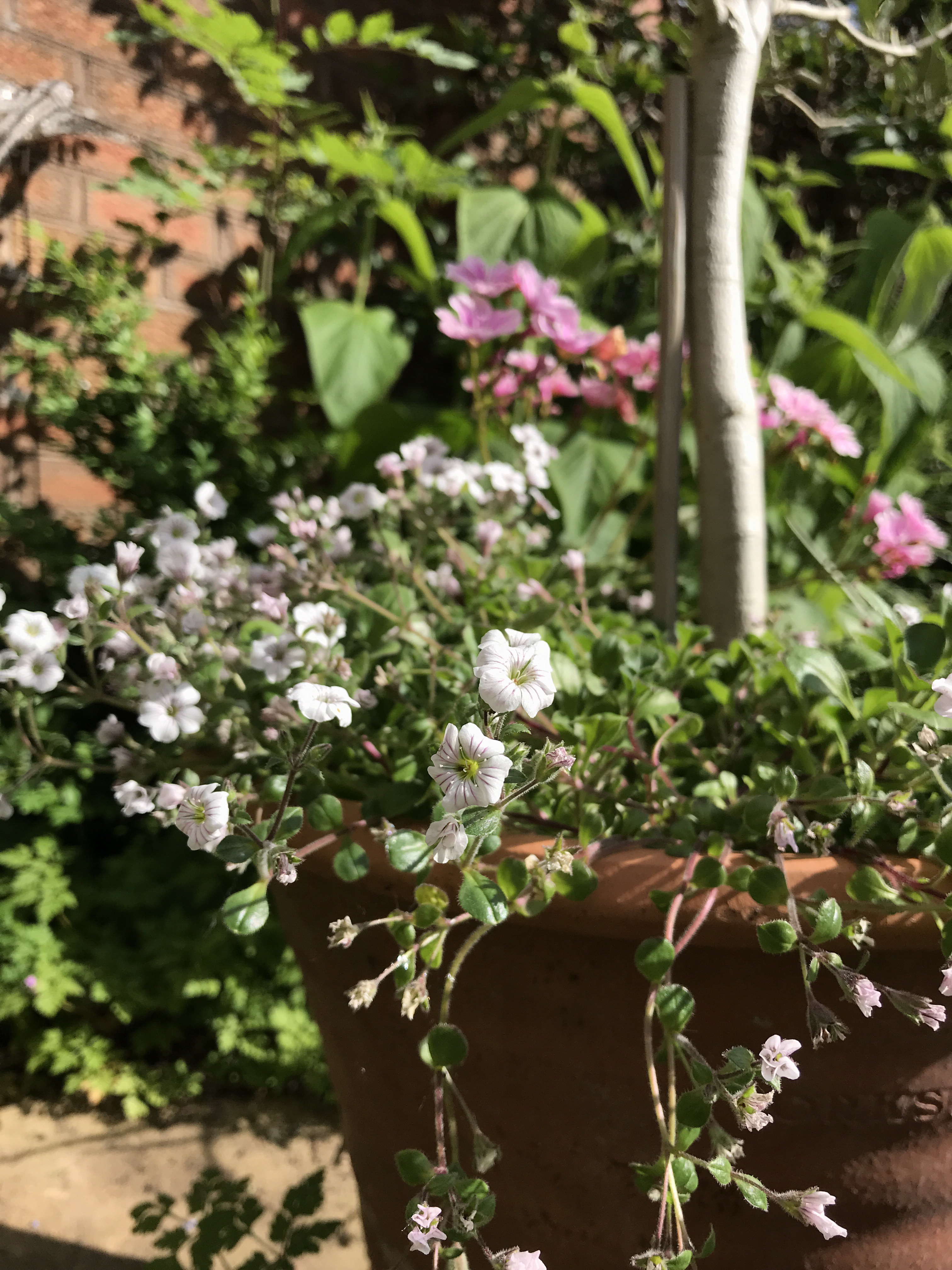
A cascading Gypsophila overflows its pot whilst flowering freely with dozens of tiny white trumpets, all worshiping the light, while from its Lewisia neighbour rise numerous slender stalks bearing exquisite pink blushed floral disks.
Gypsophilla cerastioides.
Accompanying the above mentioned delicate beauties are many cherished terracotta pots, each supporting a carefully chosen and treasured plant. The plants are not all star performers, some being the most ordinary specimens, but they’re my selections, my collection, and I appreciate each and every one for its own qualities. Collectively, they are my garden.
I have to say, there’s a good few immortal and less attractive plastic pots in use too, which refuse to die. Mind you, I can’t remember when I last threw a plastic pot away, as ‘they’ll all come in handy at some point’. If they’re here now, we might as well use them.
Overriding the flowers just now the foliage reigns supreme, with many textures and forms blending together in communities possibly never to be found in the wild. I would like to say it makes for a lovely floral display, or it’s a tapestry of colour, but to be honest it’s mostly green foliage, and I love it all the same. All that juice moving through the tiny vascular systems – refreshing, fascinating and energy giving.
Ensette ventricosum ‘Maurelii’
Lighter, clearly fresher foliage can be seen on a range of
evergreen plants, from a pot restricted cedar in its early stages of topiary
formation to a cloud trimmed, shrubby box in a heavy clay pot. Still, I can see
at least a dozen different plants in flower, (not including the lawn daisies!) with
the promise of many more to come.
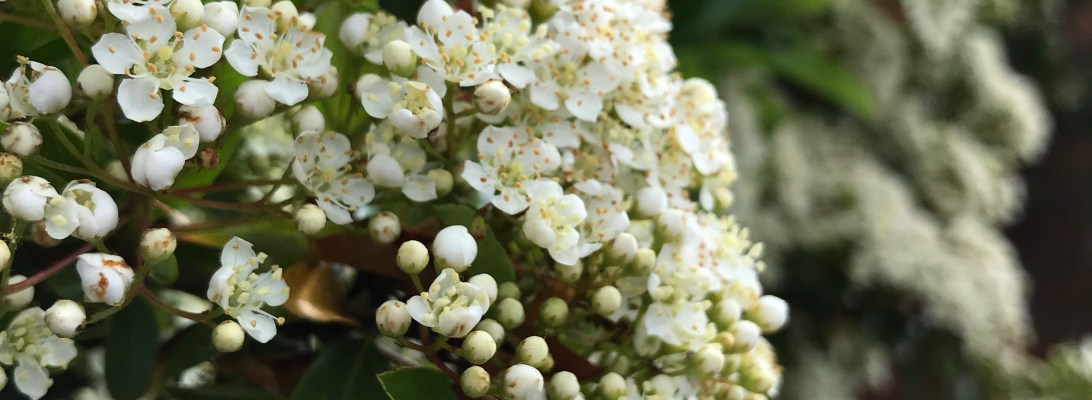
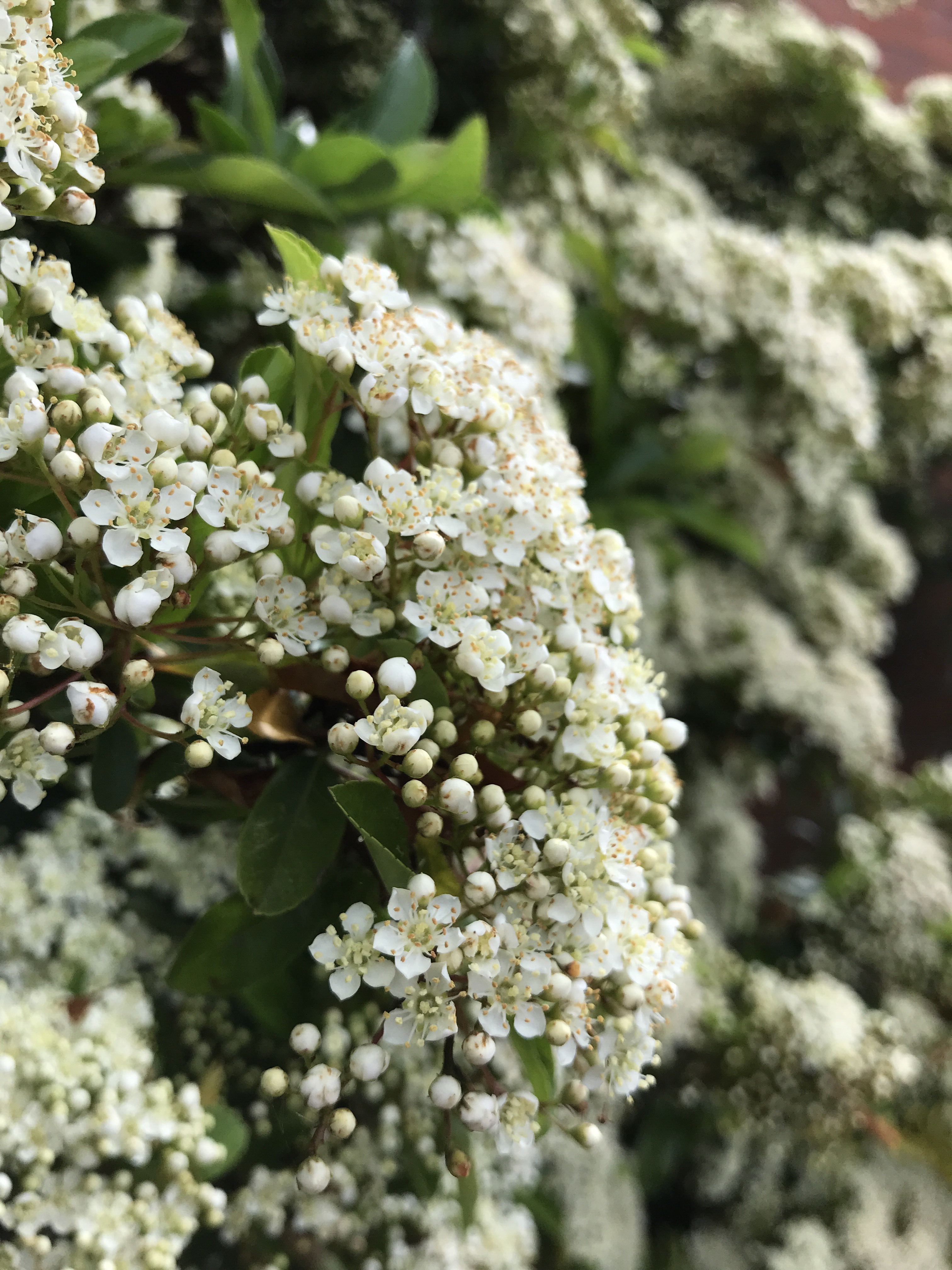
A curving rear wall supports a Pyracantha, which to my mind has been neatly trained over many years. It is just now reaching its first annual climax as it begins to burst its many champagne coloured flower clusters. I particularly like the informal holes where birds fly in to go bug hunting.
Pyracantha.
Along another border, waist high Miscanthus is beginning at
last to own its space, whilst beneath and between forget-me-nots, the happiest
of accidents light up the ground.
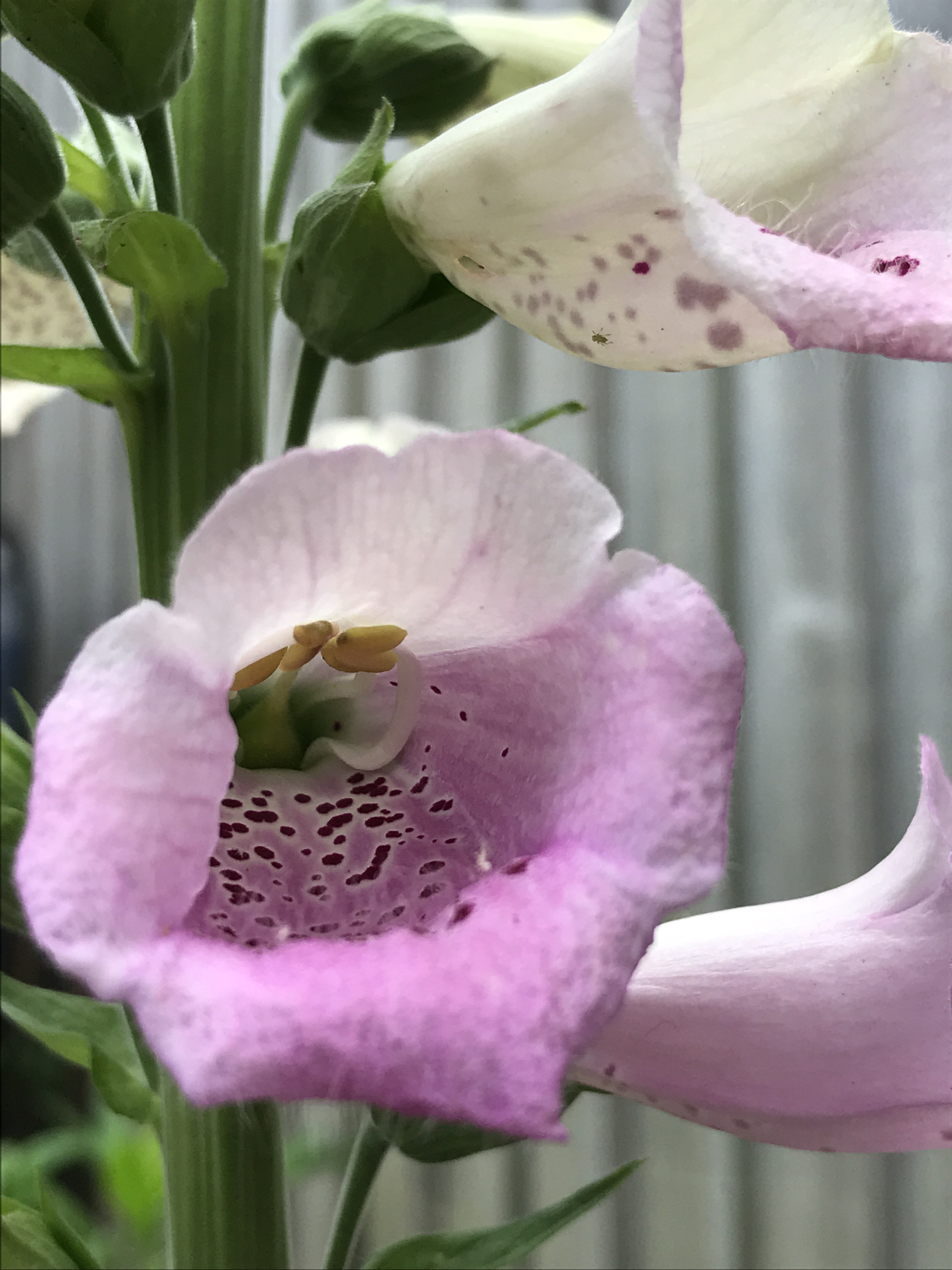
Directly opposite, the purple and mauve bells hang in fanned clusters from stout hairy stems, above the most giving of comfrey leaves. Beside this another happy accident, a Welsh poppy, demands attention with its wide open, paper-like orange petals.
Digitalis purpurea.
Just a little further away a darkly coloured bugle sits unobtrusively beside a towering foxglove, its own statuesque form leaning slightly to catch the light. Each and every year I’m wowed by the strength and beauty of each little flower tube.
And finally on the face of the fence, and arching from a stringy framework of dubious strength climbs a young clematis, its white twisted petals finally open now to appreciate the sunlight. Of course, it wants to scramble every which way I don’t want for it, but it’s a delight nonetheless.
Clematis montana.
It’s a complicated but fun mix of pots in my garden, and especially lovely in May; probably my favourite month. Whether it is a borrowed garden or a gardener’s garden, or a bit of a shambles I don’t mind; it’s my oasis and it’s imperfectly perfect for me just now. I hope your gardening space is equally challenging, delightful and inspirational, and I’d love to hear about yours.
I have to admit some frustration when I hear people wishing the winter away. Weather can wreak havoc with so many things like the daily commute, or weekend getaway, and can seriously delay schedules for one thing or another – I get that. Continue reading →



 Gardening Ways