My discovery of an ill-fated tree on a wooded hillside, a tree striving to survive and play its part for our world – a reworked essay from Gardening Ways 2017.
Time travelling back to a tree planting day on a gentle hillside a century or so ago, I picture a fresh-faced country character with their sleeves rolled back and a bead of sweat beneath their flat cap, standing back to admire their work. They, like us now would have wanted only the best for this tree that I now stand before, especially after digging into this heavy ground that I know to be stone filled and stubborn.
As for any tree planter today, our character would have wished for this tree to establish well and prosper, feeling equally sorrowful and comforted knowing it would hopefully remain long after they themselves had breathed their last. Nodding to the future then, they’d have prayed for a mild season or two to ensure that its shoots would get away and its roots would establish well, binding the tree to that spot for generations to come.
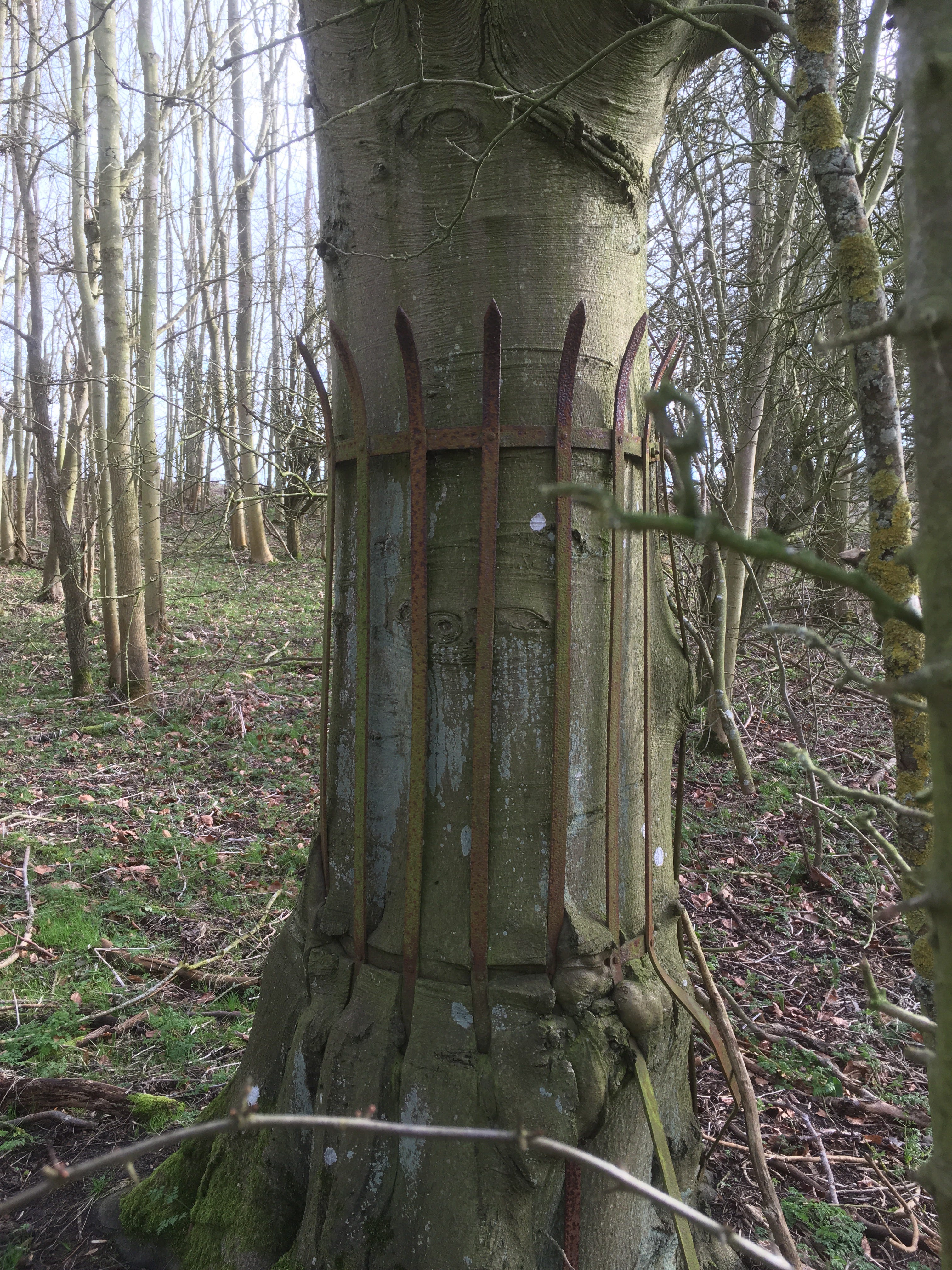
After firming down clods of earth with the heel of a hobnail boot, the planter would likely have scooped water from the nearby lakeside to settle its roots, then fixed in place a strong protective frame to guard it against attack; a metal cage likely to have dwarfed the infant tree but certain to keep it from harm. Little did they know that despite the most caring of intentions, their actions condemned the tree to a torturous future.
Maybe, as an assumption after all that hard work, our tree planter was called away to fight in the War, for given the tree’s girth it must arc back a century or so. If not the war, then perhaps our character moved on to another estate, reassured that their tree would remain upstanding and in good care; after all, no one would pay for such work, only to let it go to waste. Whatever the actual story, all I can know is that beyond a most successful planting task, this woody survivor was left to its own devices.
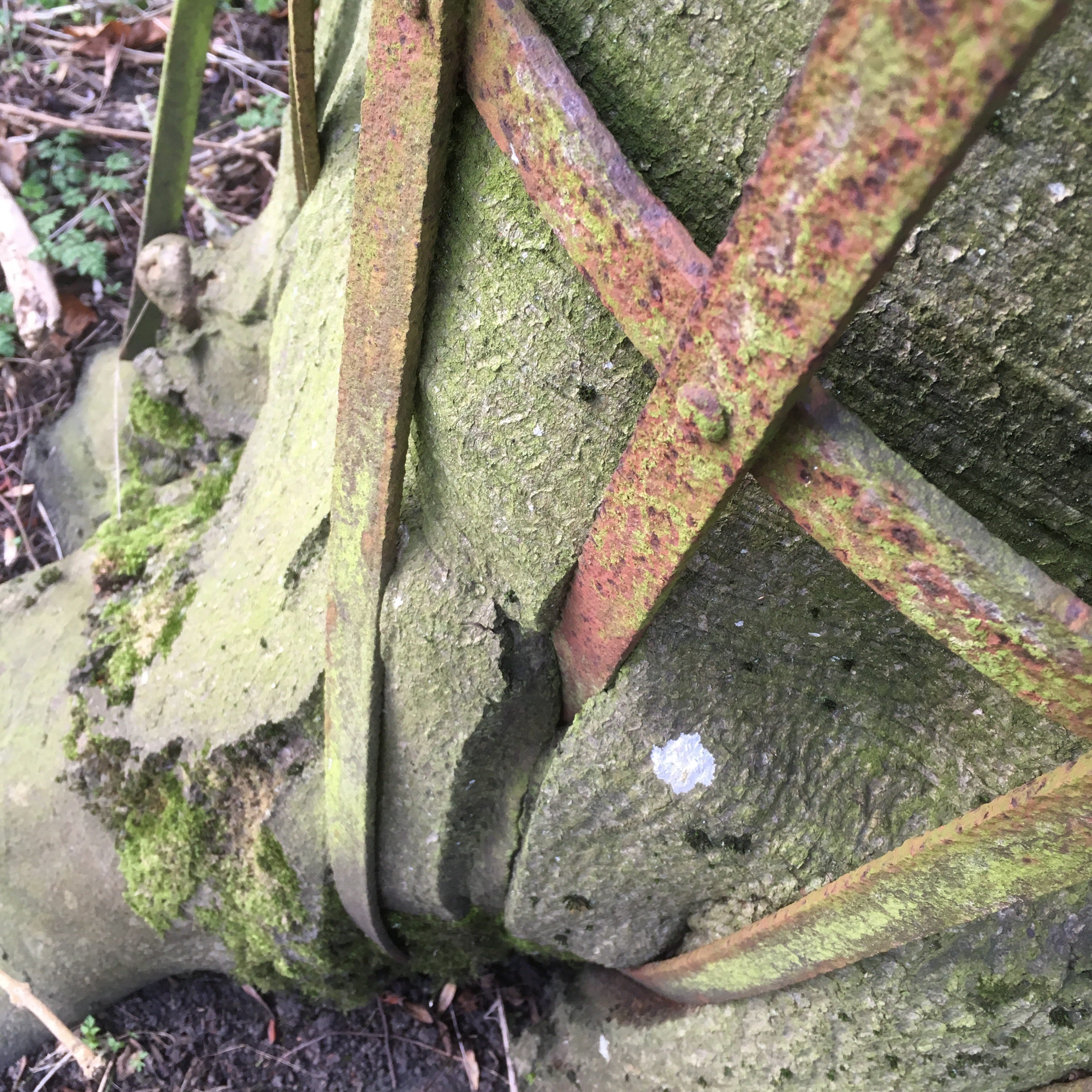
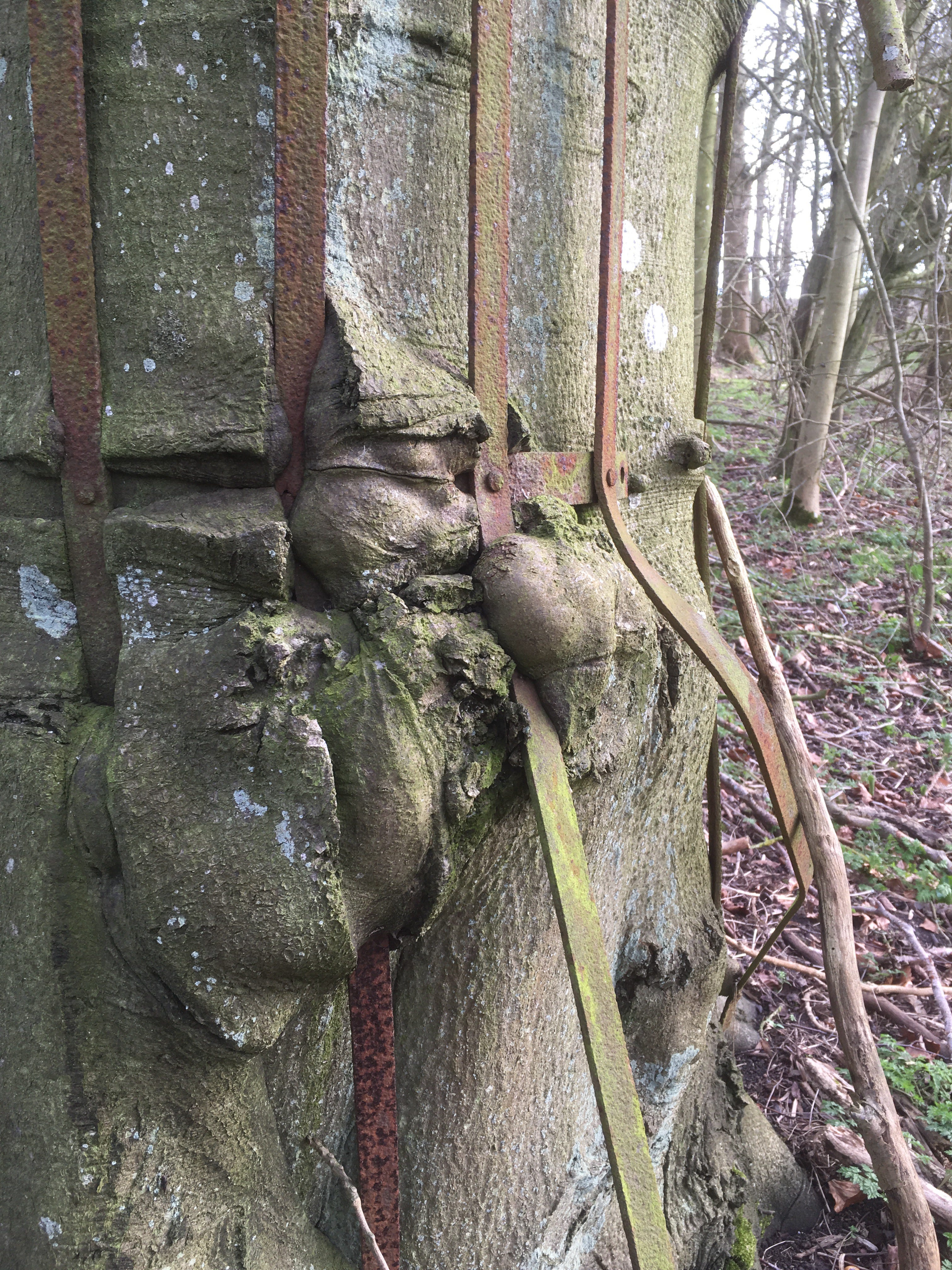
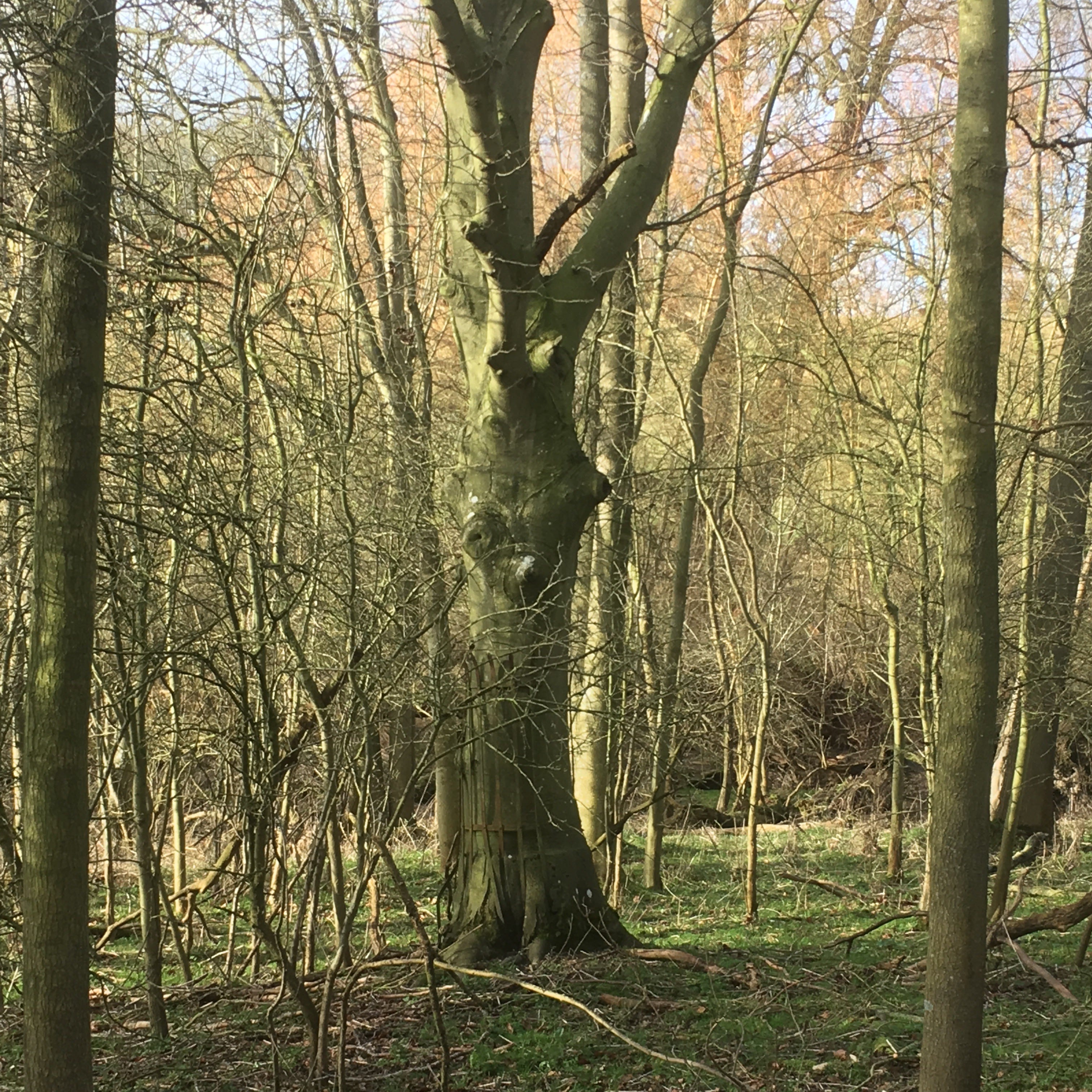
This tree however, despite growing away nicely has met with challenges, both from encroaching woodland and, sadly, from the very cage originally employed to ensure its future. Our tree, I’m sorry to say, has a decidedly uncertain future.
Situated on a gradual slope that forms part of an historic designed landscape, on land once sculpted and honed to one person’s perfection, this beech tree was a single parkland specimen with a free ticket to send its branches far and wide. Somehow though it appears that its overseers, by intent or negligence, took their eyes of the game.
Our tree with a stout trunk of around four metres, sports a relatively well-formed crown given its constrictive circumstances. Its lower limbs, having succumbed to shade forced upon it by neighbourly planting have been lost, and now lie crumbling where they fell on the woodland floor. All remaining limbs by comparison stretch upward at sharp angles, reaching for the light and trying to elbow aside any pretenders to the throne – none of which really have the strength to seriously challenge our beech just yet. This tree, a wounded survivor with lichen patched bark and rusted ironwork shackles blends effortlessly with its surroundings, as if it was meant to be.
Seeking a story, I’m encouraged to believe our tree was initially planted in open parkland where its canopy would, in time, provide shelter for grazing animals. Given full light it would have spread its limbs wide towards the sun, closely following the artificially sculpted contours of the land. This tale is, I reason on a few scraps of evidence, founded in a landscape turned over to artistic desire, albeit one with a financial imperative. Our tree, therefore, a single living part of a much grander scheme, was intended to prettily clothe this hillside whilst not obstructing the farming game.
Whilst our tree might have arrived with the best of intentions, its fate seems to have been sealed with a change in the wind. At some stage a new fence was added to the hillside just a few decades ago, sealing our tree into a new parcel of woodland and transforming it from a fine parkland specimen to another tree in the woods. Indeed, it seems hard to fathom how the woodland planters at the time could have turned a blind eye to the metal rings around our beech, when back then they could more easily have been removed.
Today, the tree about which I write now sits quietly shackled in the shade, struggling to grow and certainly not thriving as intended. Our planter’s tree has been consumed by a woodland that suffocates and stifles, curtailing its intended form and function. If only they could see what had become of their sapling, they’d likely fill the air with frustration, their lungs blowing-up a furious storm to flatten the twiggy challengers.
This tree’s story typifies those often repeated across the land, one of changes to how we plant, what we plant and where. Whilst our tree might have taken one for the team as people say, move forward we must, as trees need to be planted: and lots of them if our kind is to stand a chance of survival.
New land managers will continue to go and come, as no one lasts forever, and change is inevitable. I urge you though, if you’ve a planting opportunity, to look back to what has gone before and seek to treat with reverence the work of our forebears, for whilst their motives were different, they often meant well.
Our tortured tree then, despite its will to live and our desire to hold it dear, appears to have been the right tree, in the right place at the wrong time, and those who might have held a connection were simply playing their part. It may be a minor miracle that our beech tree continues to survive, though certainly a casualty of change, but nonetheless it has delivered everything asked of it and more, and despite its place behind bars and deep in the wood, it will continue to serve our world until long after it breathes its last.
Gary Webb
I’d be delighted if you’d take a moment to like and share – thank you.
 Gardening Ways
Poor tree . . . and such a beauty, too. All too often, we’ve moved to rural homes where living trees have been used as fencing posts, with barbed wire deeply embedded in their bark and impossible to remove. It makes me very sad, they are worthy of our honour and respect especially as you quite rightly point out, they serve the world.
LikeLiked by 1 person
I’ve witnessed this too far too many times and it saddens me too. As a society we can do better for sure… maybe the time for trees is now coming, with large tree planting targets in many countries – let’s hope they’ll be well cared for going forward.
LikeLiked by 1 person
Just looking at your images of the tree stuck in those metal braces is giving me shivers. I wish, as you mentioned, something had been done when it was still possible to remove it. ☹️
LikeLiked by 1 person
I feel just the same, they’re painful images for sure…
LikeLiked by 1 person