Food plants and flowers aren’t always seen as bed companions, yet there’s so much to gain from squeezing in a few ornamentals, aside from pollination of course! Let me briefly explain…
When first acquiring an allotment plot, an aspect that wasn’t lost to me was the opportunities it presented to support wildlife. As a result, one of the first areas to be established on our Warwickshire plot was a flower-focussed border, or ‘Nectar Bank’ as we call it. Wildlife borders, nectar banks, pollination stations, call them what you will, they’re undeniably valuable, but on an allotment, a space traditionally reserved for food production, should this be the norm?
If you’re familiar with my green gardening ways, I think you’ll know what my answer to that question would be, believing as I do that wildlife supporting elements should be considered in all gardens. Indeed, if you’ve paused your day
to read this, you’re likely to be very well aware of the decline in natural habitat and insect numbers, and the resulting need to seize every opportunity to support wildlife; what better place therefore, than an environment specifically reserved for growing; an allotment.
Across numerous allotment venues, it’s worth remembering that different rules will exist on what can or can’t be grown, or what features can be incorporated and so on, and it’s worth checking the guidance if you have a plot. Thankfully however in our neck of the woods flowers, in addition to produce of course, are good to grow. In fact, the growing of ornamentals on the allotment was something I noticed during my very first summertime NGS Open Day visit several years ago, where ornamentals were clearly anything but a side show. Fruit and veg’ might have been the main act across all plots, but florals were there, visibly pulling in the all-important pollinators, along with bird boxes, feeders, and ponds.
During that first open day visit I focussed with fascination on clematis clambering over arches and on sweet peas scrabbling up bound bamboo tripods. Companion plants, whether strips of annuals between rows of salads or scented shrubs placed beside sheds, even a few wildflower patches here and there; all clearly forming part of a thriving and biologically diverse community allotment scene. Some years later then, after grasping the opportunity to establish our own family allotment, there came a chance to do our bit, to not only grow some of our own food, but create some useful habitat too.
In terms of planting for pollinators, it’s worth stating that people benefit too, not just in the eating of associated crops helped along by those pollinators, but in the sensory enjoyment of seeing and smelling flowers across the year. Not only that but tending the plants benefits us too, which for the minimal input required helps to keep us active. For example, on arrival at the plot, a quick trip around the nectar bank to pull unwelcome plants or snip a few dead flower heads often works as a warmup, before allotment graft begins proper.
As for the content of our nectar bank, there’s nothing remarkable there I have to say, but there doesn’t need to be. Most plants were simply acquired as offsets or spares from our home garden, grown from seed, or purchased at one of the open day plant sales. There’s lavender, yellow-eyed grass and Dianthus, Angelica, Kniphofia or red-hot poker, some globe thistle and fennel too. We’ve also slotted in the odd dahlia, some alliums went in last autumn, and annual sunflowers too. Right now, in early November, the star of the border is a hardy Chrysanthemum, which beamed brightly at us yesterday as we arrived to harvest some carrots. The Chrysanthemum continues the almost constant floral offering this year that has brought bees and butterflies galore
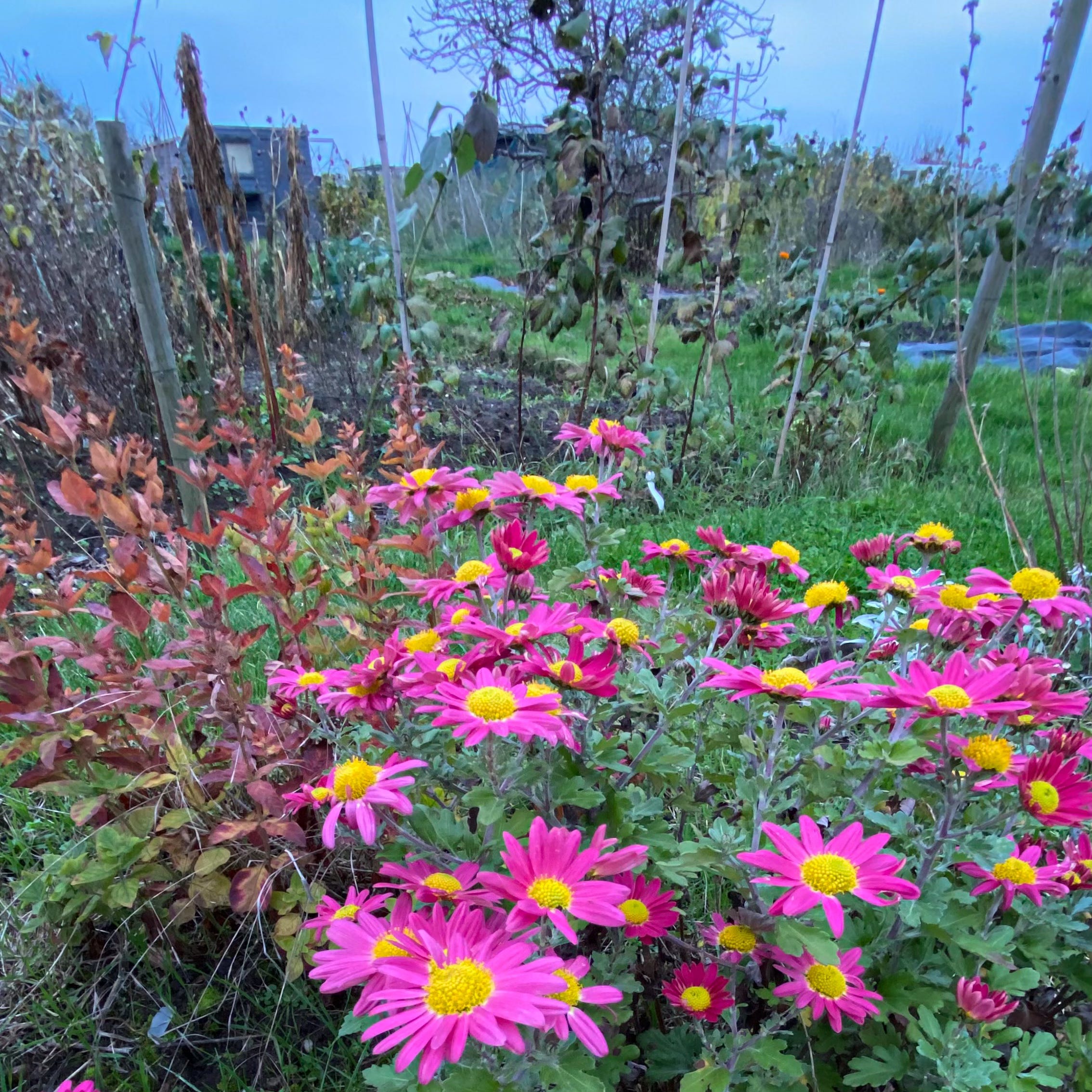
When first established, our nectar bank was a somewhat formal affair, regularly tended, its edge frequently trimmed and rogue plants rooted out. As it’s established however with plants knitting together to form something of a mass, we’ve eased back substantially from the manicuring, and have grown to appreciate the tangled diversity.
These days we simply tweak or nip and tuck the plants when something catches our attention. Neither do we cut back at this time as would normally be the case with an ornamental border, because on close inspection, ladybirds are nestled in there amongst browned folds in foliage, or can be seen taking shelter in those little gaps beneath stems. Elsewhere on the plot tidiness may need to be observed, but in our Nectar Bank, not so much.
All told, whilst our AllotofPotential allotment is ‘only’ half plot size, this diminutive flowery border, along with another wildlife area since established, is tasked with some critical work. As for the wooden bays that are busy creating compost to enrich the soil, or the hand-me-down glasshouse that produced our plot’s first tomatoes this year, the Nectar Bank, despite its modest appearance has a serious job to do: it’s there to support wildlife, as part of an unofficial, community wide initiative, to help where we can.
I shall leave you with one appeal then, should you have influence over an allotment plot or spare patch of ground. Whether you choose to sow a patch of one-time flowering annuals, plant some open centred dahlias, grow a mixed border of beautiful perennials, plant a hedge, a tree, or leave some grass to grow long, please do it with wildlife specifically in mind. Try not to see it as a solo effort, but a community wide one to support our future, trusting that our wildlife, if not our children too, will thank you for it.
Kind regards,
Gary Webb (Do check out our @AllotofPotential Instagram page!)
 Gardening Ways